Day 9 – A Visit From S.T. Nicholas

By Kimberly Evans

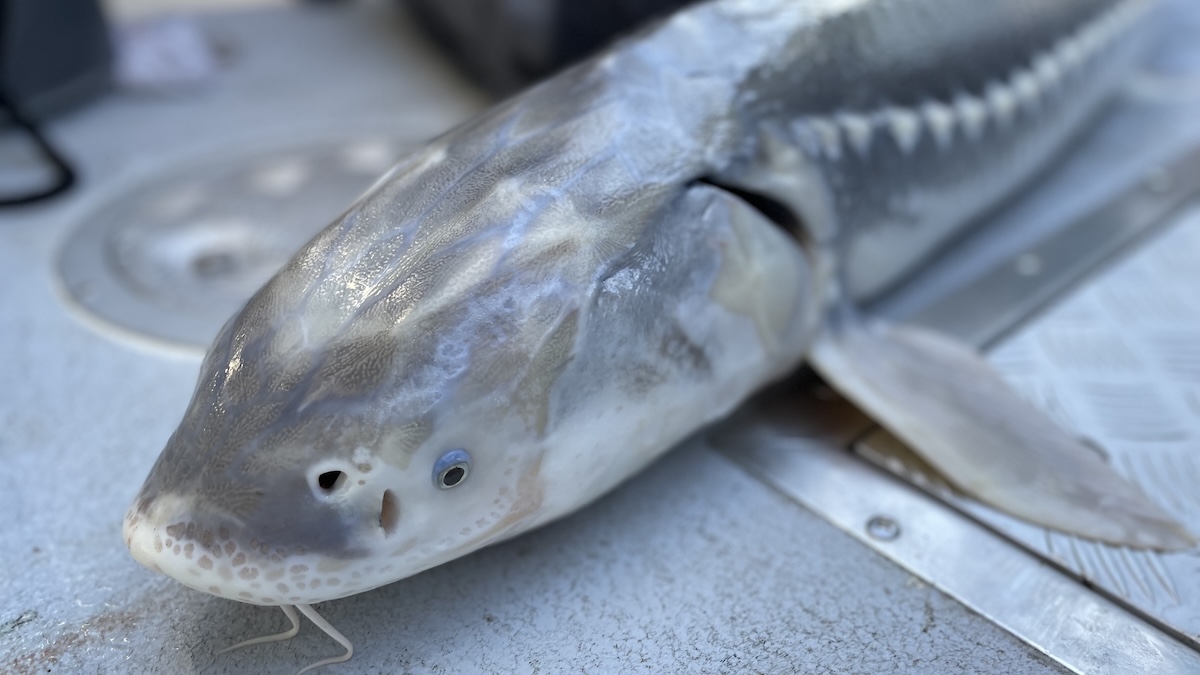
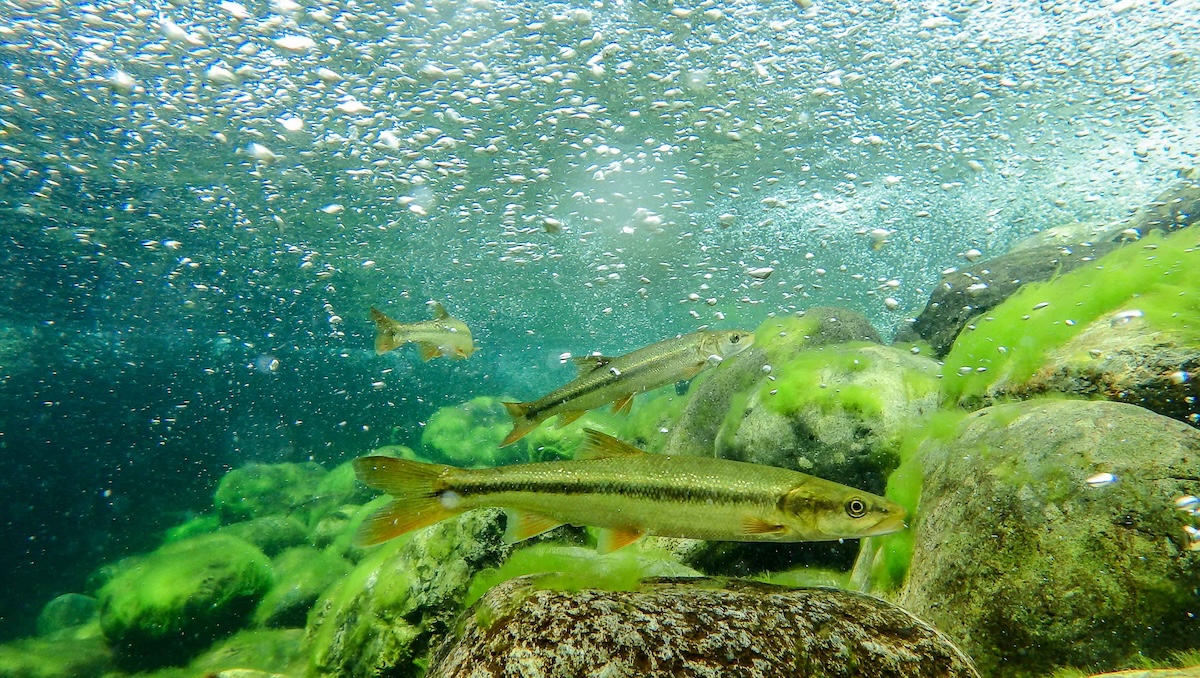
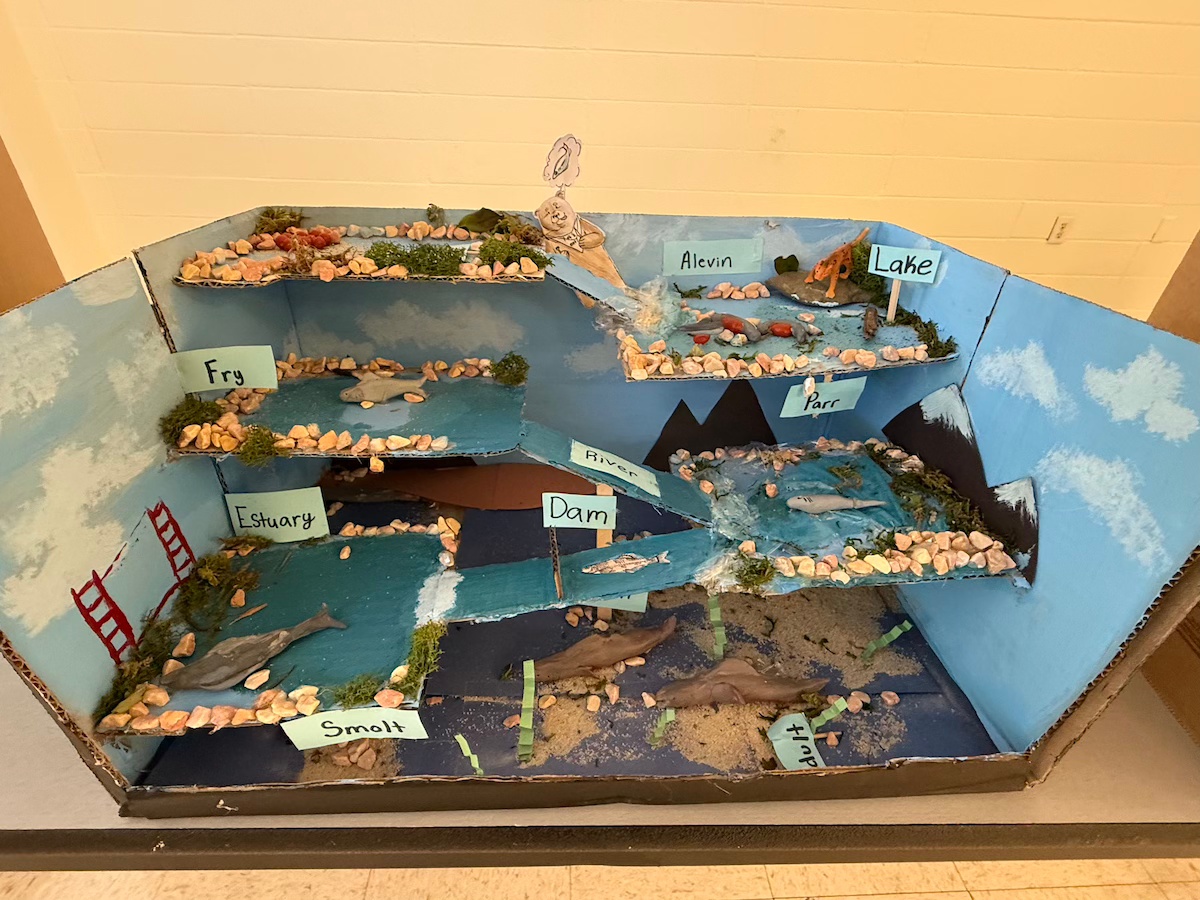
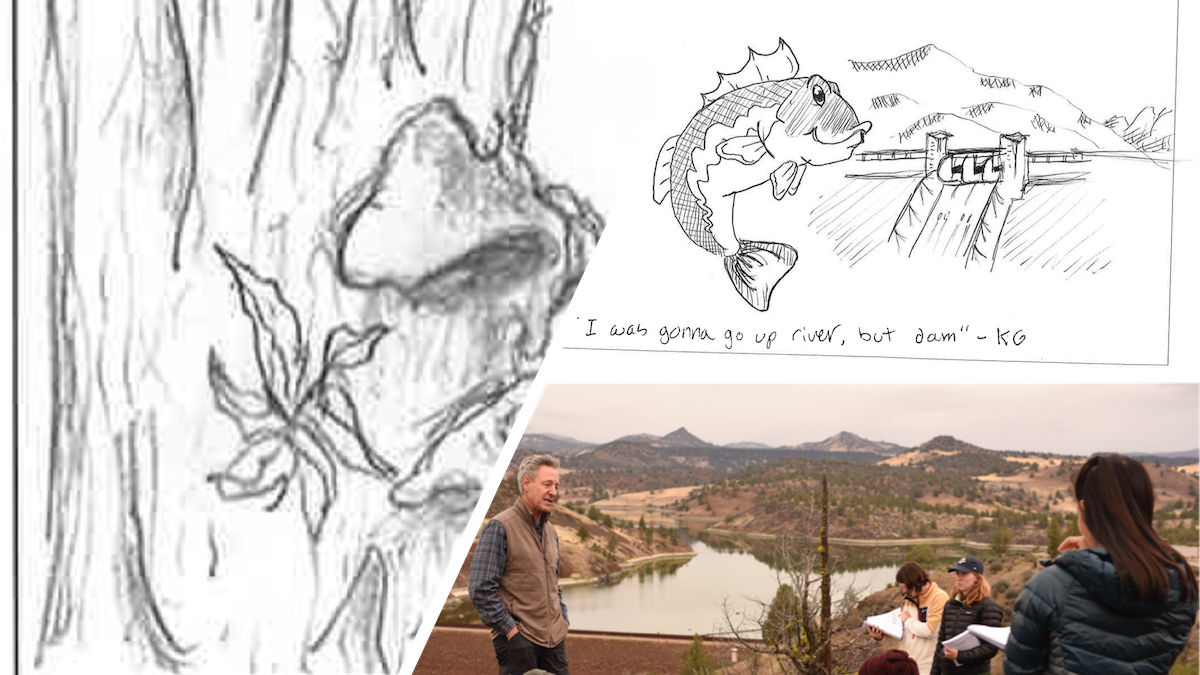
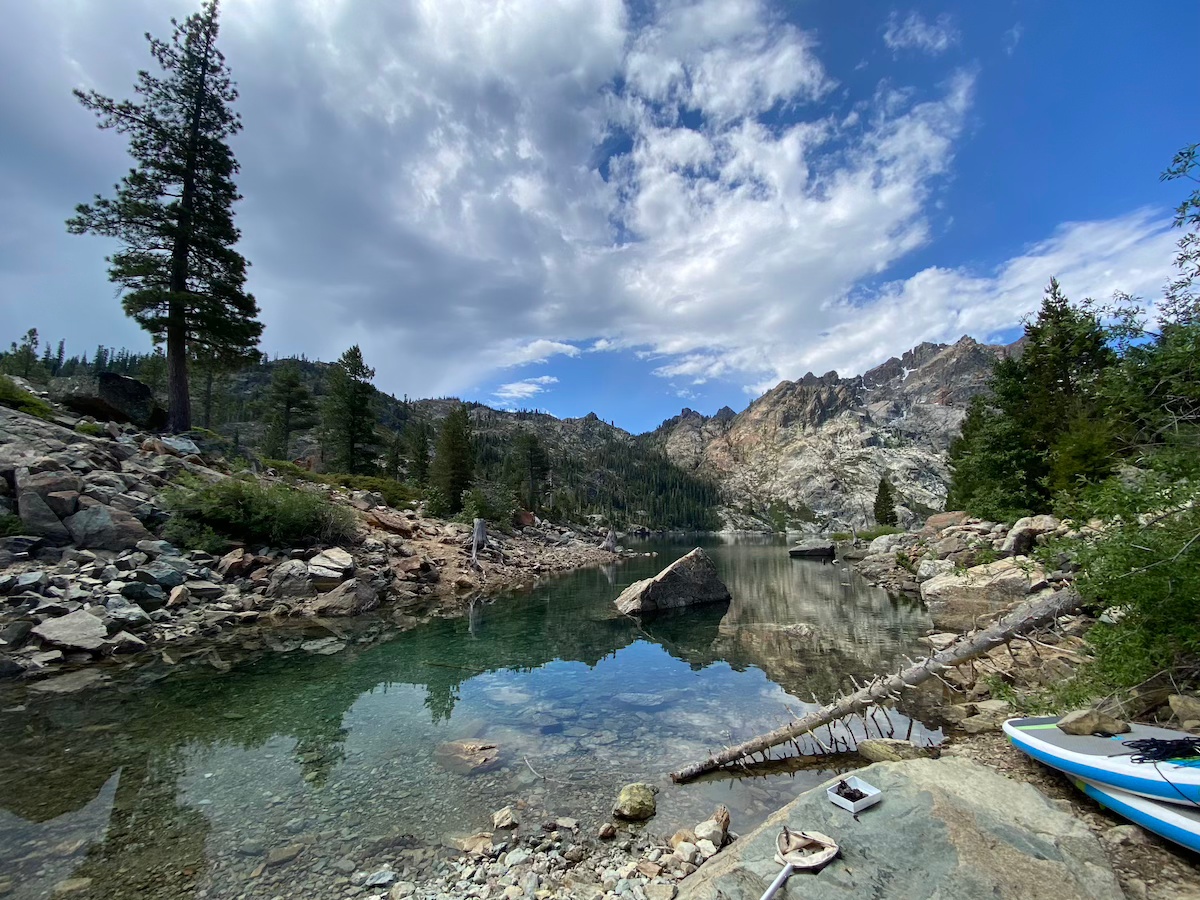
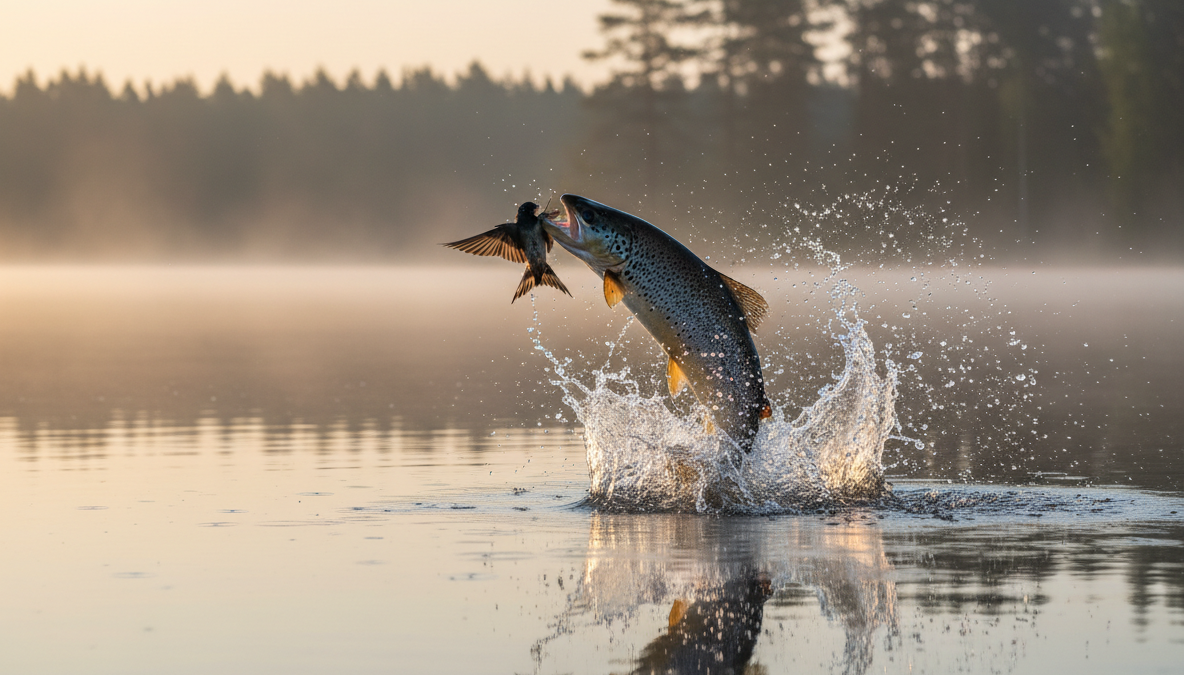
Our view of the Suisun Marsh when the weather becomes chilly, including Kimberly’s (top right, that’s me!) dazzling tule perch, Abigale’s wondrous starry flounder (middle left), Lynette’s swift Sacramento splittail (middle right), Kyle’s voracious common carp (bottom left), and Alex’s humble shokihaze goby (bottom right).

‘Twas a morning of field work, when all through our van
Not a researcher was sleeping, and to Suisun Marsh we ran;
Our waders and boots folded, all tucked in with care,
In hopes that bountiful fish, in our seines, would be there;

The researchers were nestled all snug on our boat ‘Junior,’
With visions of the otter trawl dancing on the slough floor;
Abigale Deen in her ’kerchief, and I in my cap,
Sipped on cucumber lime Gatorade, alert in a snap,

When out in the slough there arose such a clatter,
I leapt up from the stern to see what was the matter.
Up to the boat’s bow I flew like a flash,
Stared down at the water, curious of the splash.

The westerly wind on the water did blow,
Gave the illusion of movement to objects below,
When, what to my wondering eyes should appear,
But the winter seasonals and resident fishes all here,

With a slender old swimmer, so lively and quick,
I knew in a moment it must be Splittail (ST) Nick.
More rapid than eagles other fishes they came,
And he swished, and splashed, and called them by name;

“Now, tule perch! Now, common carp! Now, stickleback and threadie!
On, sucker! On, sculpin! On, yellowfin goby!

To the top of the waterways! To the cod end of the trawl!
Now dash away! Dash away! Dash away all!”

But I heard him exclaim, ere he swam out of sight,
“Happy fish-mas to all, and to all a good night!”

About the Author

Kimberly Evans is a Master’s student in the Graduate Group in Ecology. As a member of the Aquatic Research Collective (ARC) in the Center for Watershed Sciences, she studies long-term trends in the fishes of Suisun Marsh, focusing on the Sacramento Splittail.

Further Reading

Moyle, P. B., Baxter, R. D., Sommer, T., Foin, T. C., & Matern, S. A. (2004). Biology and population dynamics of sacramento splittail (Pogonichthys macrolepidotus) in the San Francisco Estuary: A review. San Francisco Estuary and Watershed Science, 2(2). https://doi.org/10.15447/sfews.2004v2iss2art3

Moyle, P. B., Manfree, A. D., & Fiedler, P. L. (Eds.). (2019). Suisun marsh: Ecological history and possible futures. University of California Press. https://doi.org/10.1525/9780520957329

To celebrate 15 years of the California WaterBlog during this season of giving, consider making a gift to the Center to help us create more meaningful opportunities for students across our programs.

Posted in Uncategorized | Tagged , | Leave a comment

Day 8 – Haikus

We invited haiku submissions from CWS members and friends to be a part of the 8th day of our California WaterBlog series, “12 Days of CWS“. A haiku is a traditional Japanese three-line poem (5-7-5 syllables) that focuses on capturing a moment, feeling, or image. We hope you enjoy… and leave us your own haiku in the comments section below!


It seeps through the ground
Replenishing aquifers
Groundwater recharge


Creeping and Crawling
California Invasive
Water Hyacinth


Toils All Day Long
An Indoor Ecologist
Will I go Outside

Danube River, Dürnstein, Austria. PC Christine Parisek 2025.

Valley fog lifts up
Feathers flutter through orchards
Sigh for the promise


Mosquitos floating
Mosquitos dancing for my blood
We hate you so much

Blinded by blood lust
Seeking me incessantly
The spray does nothing

[Anonymously dedicated to anyone who has done meadow work, stream work, or just any field work with mosquitos present… probably everyone. It is just something to deal with, and part of the fun of field work. :)]


Flows, feast or famine,
Flora, fauna, farms, and friends:
California.

Aerial view of wetlands. PC Ken James, CA DWR, 2025.


Watershed Building
Interdisciplinary
Full of Scientists


Water falls from high
River begins to wander
Floodplain comes alive

Putah Creek along the UC Davis campus (i.e., Pedrick Road). PC Peter B. Moyle, January  2011.

New rain is falling, 
Thirsty grounds long for storing. 
Can floods bring new hope? 
– By Helen E. Dahlke


Through a microscope
Pearl shining, a fish’s lens sits
History in layers
– By Danhong Ally Li

Adult Chinook Salmon Lens. Photo Credit: Alexandra Chu. 

Founded CWS
Jeff Mount and Peter Moyle
The Visionaries


Keys click, code won’t run
Outside, salmon spawn in streams
Life of a modeler

Putah Creek Salmon. PC Ken Davis, December 2013.


How do salmon
From distant valley rivers
Find our small creek? 

Looking for salmon
I see swirling yellow leaves
And a patch of clean gravel

On Valentine’s Day
Suckers were splashing  and spawning 
Not knowing  I was watching.

Fishing smallmouth bass 
We catch native pikeminnows.
A happy result.

On bright summer mornings
Fish dapple the creek’s surface 
Grabbing small mayflies.

– Haikus about Putah Creek, By Peter Moyle 

Putah Creek below Pedrick Road. PC Peter B. Moyle.

To celebrate 15 years of the California WaterBlog during this season of giving, consider making a gift to the Center to help us create more meaningful opportunities for students across our programs.

Posted in Uncategorized | Tagged , , , , , , , , , , , | Leave a comment

Day 7 – Pickles and Hidden Gems: The UC Davis Fish Collection

By Rachel Alsheikh

Dr. Peter Moyle and Rachel Alsheikh in the Ichthyology Collection room.

On the UC Davis campus, past the Watershed Sciences Building, past the cows and the Arboretum, there’s a nondescript building with a locked room. It’s a secret treasure trove: shelves upon shelves stacked with more than 8,000 jars of fish specimens preserved in ethanol. At over 30,000 fishes, it’s the fourth largest ichthyological research collection in the state, and it belongs to the Museum of Wildlife and Fish Biology (MWFB). If you’ve studied fish at UC Davis, you’ve almost certainly encountered the MWFB’s teaching specimens before, in a class like WFC120L or at an event like Picnic Day. A museum’s selected teaching specimens and its specimens on display get to meet the public that way, but few people have the opportunity to appreciate full behind-the-scenes research collections. Today, we’ll give you a sneak peek inside.

Distinguished Professor Emeritus and Center for Watershed Sciences co-founder, Dr. Peter Moyle established the Ichthyology Collection in 1972. It has been a time capsule for research ever since, spanning not only Dr. Moyle’s career but also those of many of his students. The resulting collection is one of the most modern representations of California freshwater and estuarine species at any institution, an important resource in the keeping of natural history. Part of the Fish Collection also consists of orphaned collections from other institutions, including the large San Jose State University collection of nearshore marine fishes, which was started by Professor Emeritus Dr. Jerry Smith, one of Peter Moyle’s first graduate students. And the Fish Collection doesn’t end there, with specimens from across the country, Hawaii to Alaska, Mexico, Sri Lanka, Antarctica, and more.

A handful of “pickled” specimens in lots: (left to right) frogfish, white-spotted puffer, guineafowl puffer, stout moray, trunkfish.

These specimens don’t sit idle, they actively contribute to research. They have helped scientists reassess fish taxonomy, clarify species phylogenies, and determine changing distributions. Their tissues have been used for genomic analysis. Some of them have even been featured on the WaterBlog for their importance as type specimens, the permanent vouchers used to describe a new species or subspecies. The oldest museum fish collections are nearly two centuries old (see the Smithsonian Institution National Museum of Natural History’s archive of the United States Exploring Expedition, 1838-1942): it’s impossible to predict everything collections-based research will discover in the future. Needless to say, we’ll be working with this collection to help find out.

To learn more about the Museum of Wildlife and Fish Biology, please visit mwfb.ucdavis.edu. You can also contact mwfb@ucdavis.edu or ralsheikh@ucdavis.edu

You can follow the MWFB on Instagram @museumofwfb.

If you’re interested in supporting the Fish Collection, you can contact us or do so here.

About the Author

Rachel Alsheikh is a Museum Specialist at the Museum of Wildlife and Fish Biology. She has been working at the MWFB since she was an undergraduate student. When she graduated in 2020, she also began working as the Project Manager for the Center for Watershed Sciences. She loves museums and museum specimens.

Further Reading

From the MWFB 

California’s Freshwater Fishes. Museum of Wildlife and Fish Biology.

Moyle, P. B., Buckmaster, N., and Su, Y. Taxonomy of the Speckled Dace Species Complex (Cypriniformes: Leuciscidae, Rhinichthys) in California, USA. Zootaxa. 2023; Vol. 5249, No. 5: 501–539.

Moyle, P. B. and Campbell, M. A. Cryptic Species of Freshwater Sculpin (Cottidae: Cottus) in California, USA. Zootaxa. 2022; Vol. 5154,  No. 5: 501–527.

Baumsteiger, J. and Moyle, P. B. A reappraisal of the California Roach/Hitch (Cypriniformes, Cyprinidae, Hesperoleucus/Lavinia) species complex. Zootaxa. 2019; Vol. 4543, No. 2: 221–240.

About natural history collections 

The Lost Species: Great Expeditions in the Collections of Natural History Museums by Christopher Kemp, Dry Storeroom No. 1: The Secret Life of the Natural History Museum by Richard Fortey, Curators: Behind the Scenes of Natural History Museums by Lance Grande.

Holmes, et. al. Natural history collections as windows on evolutionary processes. Molecular Ecology. 2016; Vol. 25, No. 16: 864-881.

To celebrate 15 years of the California WaterBlog during this season of giving, consider making a gift to the Center to help us create more meaningful opportunities for students across our programs.

Posted in Uncategorized | Tagged , , , | 1 Comment

Day 6 – Recharging Resilience: Balancing climate grief with curiosity and purpose

By Kira Zalis Waldman 

Intro to Water Science (ESM 100) students exploring UC Davis’ water systems through field visits – where curiosity, community, and on-the-ground learning helped transform questions into purpose. Photos by Kira Zalis Waldman and Ethan Xie.

Teaching hydrology means teaching in a world where climate awareness, and inherently climate grief, often walk into the classroom before I do. Our lectures revisit now familiar concerns: shrinking snowpack, overdrafted aquifers, and the uneven and unjust burdens so many California communities carry. The weight of that knowledge is real. As land subsides and floods deluge, young people at pivotal moments in their early adulthood are asked to absorb the unsettling truths of a human-altered water cycle. It can feel overwhelming, for them and for me, especially as they begin imagining their place in the water world. (It’s Time to Talk about Climate Anxiety, “This Book Is the Cure for Climate Anxiety”)

This fall, while serving as a teaching assistant for the Intro to Water Science (ESM 100), taught by Dr. Helen E. Dahlke, I observed how curiosity repeatedly broke through climate grief in the classroom and on field visits. The heaviness of the daily lessons (increased evapotranspiration, water-quality degradation, soil moisture decline, etc.) was met with voices and questions that inspired me – that recharged my resilience. On field visits to the climate station, the groundwater pump facility, and the arboretum waterway, students asked sharp, joyful questions: How does this sensor work? Why is that pump humming? Where does our campus water actually come from? What happens to our resources after floods? During droughts? Standing there in the sun or the rain, surrounded by the tools and people who keep water systems functioning, something softened. The problems felt big, yes – but the solutions felt tangible.

These moments reminded me that purpose grows where grief and curiosity meet. Students and instructors who show up with openness, humor, and wonder tend to thrive. Field-based learning helps all of us reconnect to what is still possible. It turns abstract worry into grounded understanding, and at least in our class this fall, it turns that understanding into resilience.

About the Author

Kira Zalis Waldman (she/her) is a PhD candidate in the Hydrologic Sciences Graduate Group at UC Davis, where she studies how geogenic contaminants like arsenic and uranium respond to managed aquifer recharge. She’s passionate about teaching hydrology through place-based, field-centered learning and helping students navigate curiosity and purpose in the water world. When she’s not thinking about groundwater, you can usually find her rafting rivers, backpacking in the mountains, or plotting her next living laboratory in an outside classroom. 

Further Reading

A slide I share with my students before giving a climate change lecture.

To celebrate 15 years of the California WaterBlog during this season of giving, consider making a gift to the Center to help us create more meaningful opportunities for students across our programs.

Posted in Uncategorized | Tagged , | Leave a comment

Day 5 – A Day in the Life of an Indoor Ecologist

By Jonathan Walter

Many ecologists spend substantial time conducting research in the field – but for some of us, our skillsets (e.g., statistics, mathematical models, data science) lend themselves to a different, more indoor career. Here’s what a typical workday might look like:

6:00 AM: Start the day with coffee on the couch. Gaze longingly at my green sturgeon art; wonder if I’ll ever see one in the wild.

Green sturgeon stained glass, created by Dr. Rosemary Hart of “Rosie’s Colored Glasses” on Etsy. Rosie is an Environmental Program Manager at the Department of Water Resources.

7:00 AM: Get dressed. Glance at my hiking boots collecting dust as I reach for my wing-tips.

8:00 AM: Arrive at the Center for Watershed Sciences. Wave at Carson as he is loading nets and hip waders into the back of a pickup truck, getting ready for the field as I walk into the building. Grumble to myself about the air conditioning being set too low.

8:05 AM: Park myself in front of my extra-large monitor and tile my (computer) desktop windows so I’m ready to code.

9:17 AM: Peek at the narrow triangle of blue gray sky visible out the window between my giant monitor and the adjacent buildings for the nth time.

11:06 AM: Scribble down some fun math to figure out later.

12:00 PM: Lunch time! Eat leftovers on a picnic bench so I can get my vitamin D.

12:59 PM: Back at my desk for a Zoom meeting. Set a picture from a hike as my virtual background – maybe people will think it’s from the field?

Jon’s Zoom background, Sly Park Creek, Sly Park Recreation Area, Pollock Pines, CA. Photo by Jon Walter.

1:04 PM: QA/QC some new fish movement data for the Pacific Aquatic Telemetry Hub (PATH) database. 

3:30 PM: Math time! Work on tidying up the stuff I scribbled down earlier (writing in LaTeX of course). Continue endless internal monologue about whether the assumptions that make the math simple enough to be do-able are actually reasonable.

5:00 PM: Shut down the computer and head home. Hope there’s a good hockey game on TV! 

About the Author

Jonathan Walter is a Senior Researcher at the Center for Watershed Sciences. A (jokingly) self-described “indoor ecologist,” Jon specializes in developing and applying statistics and mathematical models to study the dynamics of aquatic organisms and ecosystems.

Further Reading

An interview with Jon Walter. 2024. California WaterBlog. https://californiawaterblog.com/2024/11/17/pathways-to-research-an-interview-with-jon-walter/

Walter Lab Website: https://jonathan-walter.github.io/

To celebrate 15 years of the California WaterBlog during this season of giving, consider making a gift to the Center to help us create more meaningful opportunities for students across our programs.

Posted in Uncategorized | Tagged , , , | Leave a comment

Day 4 – The Ghost of Carp-mas Past!

By Kim Luke

Kim Luke holding a common carp (Cyprinus carpio) while sampling in the UC Davis Arboretum. Photo credit Greg Urquiaga.

Back in 2019, I began a project called the Carp Dependent Ecosystem Urgent Management (Carp-DEUM) Project. I started this project as an undergraduate and continued it as a junior specialist and graduate student until 2022. The project was focused on the common carp (Cyprinus carpio) population in the UC Davis Arboretum and the potential benefit of excluding carp on water quality. While we caught plenty of carp during our sampling, we also got to look at the overall fish community and found lots of black bullheads (Ameiurus melas), green sunfish (Lepomis cyanellus), and native Sacramento blackfish (Orthodon microlepidotus). 

There were two phases to the project, a sampling phase and a carp exclosure phase, and both came with their own obstacles. It turns out steep concrete banks are not good seining beaches, and creating areas that fully exclude carp requires much more effort than I, as an undergraduate, could manage. With help from my labmates, I learned new sampling techniques and came up with solutions to keep the project going. And while the project had its hiccups, it gave me management experience early on in my career and provided hands-on sampling experience right on campus to about a dozen undergraduate students. Even projects that don’t work out as planned can offer valuable learning experiences. Good science can be messy and hard!

And the project isn’t done yet. Over the last few years, since the project ended, the UC Davis Arboretum has undergone construction to restore areas to a more natural wetland habitat, including areas near places the Carp-DEUM project sampled. Since that construction finished, another undergraduate at UC Davis has started studying the fish community to see how fish communities and water quality have changed post-restoration. Be sure to keep your eyes peeled for future blog posts about their work!

If this visit from Carp-mas past has filled you with fishy holiday spirit, try making some Gingerbread fish! I used this recipe for the gingerbread cookies and this recipe for the icing. Don’t forget the almond sliver scales!

Gingerbread fishes by Kim Luke.

About the Author 

Kim Luke is an environmental scientist at the Delta Stewardship Council and the current president of the California-Nevada chapter of the American Fisheries Society. She worked at the Center for Watershed Sciences from 2019-2024, starting as a student assistant and working her way up to assistant specialist.

Further Reading

Luke, K., J. Durand, R. McConnell, A. Sturtevant, N. Suzuki, A.L. Rypel. 2020. Initial Sampling of the Carp-DEUM Project. California WaterBlog.

Luke, K., and Brian Williamson. 2020. Contemplating the Carp. California WaterBlog. 

Main Project Page: https://watershed.ucdavis.edu/project/carp-deum

To celebrate 15 years of the California WaterBlog during this season of giving, consider making a gift to the Center to help us create more meaningful opportunities for students across our programs.

Posted in Uncategorized | Tagged , , | 2 Comments

Day 3 – An Ode to Gulls

By Lynette Williams Duman

Clockwise from left to right: The Heermann’s Gull, Bonaparte’s Gull, Short-billed Gull, and Lesser Black-backed Gull. A small slice of winter visitors to California. (Images courtesy of Lynette Williams Duman and Konshau Duman).

There is no better cure for the winter blues than looking at birds, and there is no better group of birds to look at in the winter than gulls. In California, winter is the time of massive gull flocks that will commute between landfills, beaches, rice fields, reservoirs, and rivers. No matter where you are, odds are that there will be a gull nearby.

Take the Heermann’s Gull (Larus heermanni), who, instead of following the expected winter migration south with its avian compatriots, chooses to move north in the winter and delights coastal Californians from San Diego to Mendocino (and beyond!), but rarely ventures inland.  

Or consider the adventurous Bonaparte’s Gull (Chroicocephalus philadelphia; named for Napoleon’s ornithologist nephew, Charles). They charm us in winter with their acrobatic flight, petite stature, and gregarious nature, but in the summer, they nest arboreally (!!) in scattered spruces near bogs and lakes in far northern Canada and Alaska. 

We also get rare visitors to our coast in the winter. The Lesser Black-backed Gull (Larus fuscus), a species most commonly found in the Old World, has become an infrequent winter invader in California. If you have the pleasure of scanning through a flock of gulls, keep your eyes peeled for rarities, like this individual (Figure 1) from the Davis Landfill in February 2022.

Sometimes there are gulls that taxonomically we are… not sure what to do with. The Short-billed Gull (Larus brachyrhynchus) was once a subspecies of Mew Gull (Larus canus; “Mew” refers to an old Dutch word for “gull” – so yes, that means they were technically called the “Gull Gull”). Mew Gull was taxonomically split in 2021 and is now two separate species: Short-billed Gull and Common Gull. This thrilled many birders, as now there are two additional (difficult to identify) gull species to find every winter!

So whether you are gull-curious or a fully-fledged lariphile, keep an eye out for our beautiful, enigmatic winter visitors.

* To celebrate 15 years of the California WaterBlog during this season of giving, consider making a gift to the Center to help us create more meaningful opportunities for students across our programs.

About the Author

Lynette Williams Duman is a PhD Candidate in the Aquatic Research Collective (ARC) at the UC Davis Center for Watershed Sciences, where she studies multi-benefit tidal restoration. You can often find her at the landfill looking at gulls.

Further Reading

Burger, J. and M. Gochfeld (2020). Bonaparte’s Gull (Chroicocephalus philadelphia), version 1.0. In Birds of the World (A. F. Poole and F. B. Gill, Editors). Cornell Lab of Ornithology, Ithaca, NY, USA. https://doi.org/10.2173/bow.bongul.01

Burger, J., M. Gochfeld, G. M. Kirwan, D. A. Christie, and E. de Juana (2020). Lesser Black-backed Gull (Larus fuscus), version 1.0. In Birds of the World (J. del Hoyo, A. Elliott, J. Sargatal, D. A. Christie, and E. de Juana, Editors). Cornell Lab of Ornithology, Ithaca, NY, USA. https://doi.org/10.2173/bow.lbbgul.01

Islam, K. and E. Velarde (2020). Heermann’s Gull (Larus heermanni), version 2.0. In Birds of the World (P. G. Rodewald and B. K. Keeney, Editors). Cornell Lab of Ornithology, Ithaca, NY, USA. https://doi.org/10.2173/bow.heegul.02

Moskoff, W. and L. R. Bevier (2021). Short-billed Gull (Larus brachyrhynchus), version 1.1. In Birds of the World (S. M. Billerman, Editor). Cornell Lab of Ornithology, Ithaca, NY, USA. https://doi.org/10.2173/bow.mewgul2.01.1

* As always, but especially during “12 Days of CWS,” we’d love to hear from our readers too! Whether you’ve been part of CWS before or just love observing the seasons, appreciating a nice lake, or have your own naturalist adventures, drop us a comment below. Share with us a surprising nature encounter, your favorite aquatic species, or a bit of mischief – someone else might nod along and share a smile! We’re excited to share “12 Days of CWS” with you, and for you to be a part of it too! 

Posted in Uncategorized | Tagged , , , | Leave a comment

Day 2 – Fish Eye View

By Miranda Bell-Tilcock

Adult salmon eye lens. Photo Credit: Johnson-Jeffres Lab.

That’s no moon. 

That is the lens of a fish eye. While it looms large in the photo, this lens is tiny, approximately 3-5mm in diameter, similar to a small bead on a friendship bracelet. How did we even capture such a zoomed in photo of a small lens? We use a very nice built-in camera microscope to capture images like the one in today’s blog. Not only do these microscopes help us capture beautiful images, they also make training a lot easier, since they have a screen that lets other people see what you are doing under the microscope in real time!

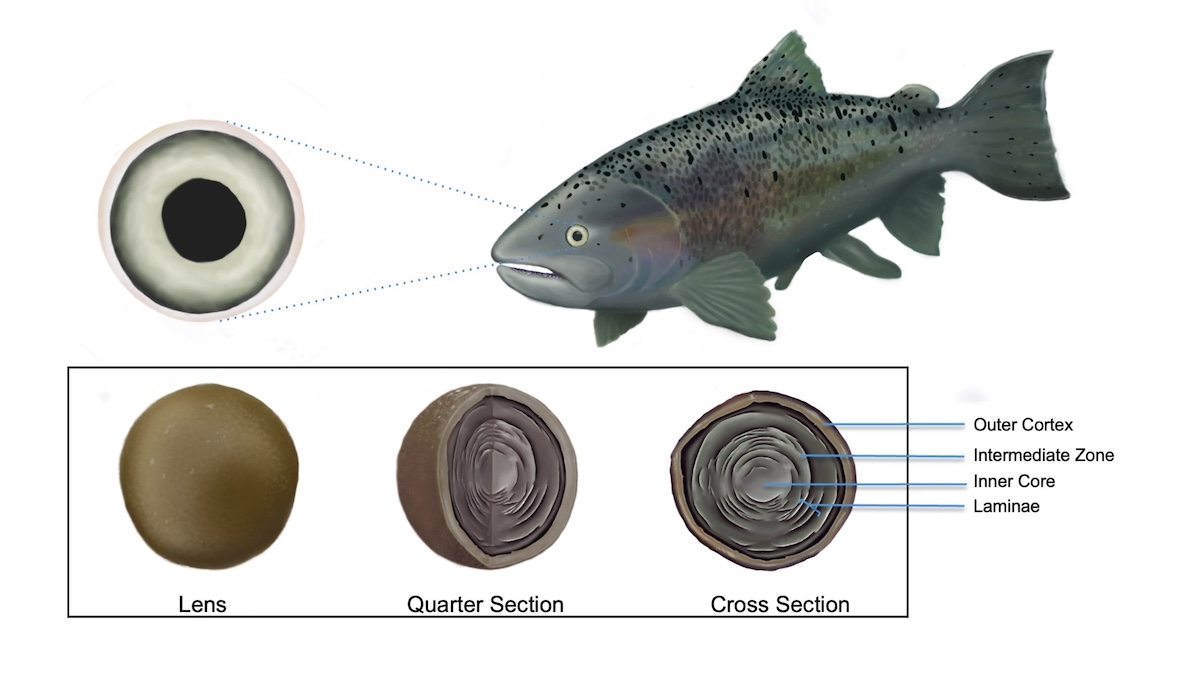
While they’re small, they can provide so much information for researchers. Fish lenses are made up of layers and have the ability to reconstruct the diet of the fish, which can also help inform researchers of what habitat that fish used throughout its life. One study was able to use fish eyes to differentiate habitats that juvenile salmon can use while in freshwater such as the hatchery, floodplain, or staying within the river. Lenses are also being used to better understand thiamine deficiency in Chinook Salmon by identifying what the salmon were consuming while living in the ocean. Another study looked at how different shark eye lenses were compared to bony fish like salmon! But peeling technique is also important. And that’s just the tip of the iceberg… or the outer peel of the lens! There’s still lots to learn about fish eyes and how we can use them to better understand fish in our ecosystems. 

About the Author

Miranda Bell-Tilcock is the Deputy Director of the Center for Watershed Sciences (CWS). Prior to this position change, her research at CWS focused mainly on fish eye lenses and isotopes, such as Chinook Salmon eyes, to reconstruct their life history. Her work on fish eyes and isotopes was featured on National Public Radio’s Science Friday. Miranda enjoys hanging out with her three children when she’s not working, as well as baking bread and other tasty treats.

Further Reading

Bell-Tilcock, M. 2021. Fish eyes: the hidden diet journal. California WaterBlog.

To celebrate 15 years of the California WaterBlog during this season of giving, consider making a gift to the Center to help us create more meaningful opportunities for students across our programs.

Top and bottom left: Fish eye lens as seen under the microscope. Right: Assistant Specialist Ally Li works on a fish eye lens, with what is being seen under the microscope displayed on the laptop screen. PC: Johnson-Jeffres Lab.

Posted in Uncategorized | Tagged , , , | Leave a comment

Day 1 – Introducing “12 Days of CWS”

By Christine A. Parisek and Miranda Bell-Tilcock

The California WaterBlog celebrates its 15th anniversary this January 2026, and so we thought we’d try out something a little special and festive this month. This December, we’re piloting a new short-post format series that will open up a small window into a day in the life of the Center for Watershed Sciences (CWS), the organization that produces this blog. The posts will celebrate our community – both past and present – and offer some holiday cheer! 

Each day, for the next 12 days, we’ll share a brief post from a current or past CWS member that, with a scoop of merriment and a dash of mischief, gives our readers a glimpse into what we do. You’ll see a range of posts over the next few days that will give you a fish eye’s view of the world, offer an ode to gulls, give a sneak peek into a day in the life of an indoor ecologist, celebrate winter seasonal fishes of Suisun Marsh, feature tasty recipes, and more.

To celebrate 15 years of the WaterBlog during this season of giving, consider making a gift to the Center to help us create more meaningful opportunities for students across our programs.

A gift to Friends of CWS will support:

  • Ecogeomorphology classes that teach cross-disciplinary collaboration in expedition settings
  • Research to solve water problems in California and the Western US
  • Student and public engagement in California and Western US water problems
  • Strategic initiatives and support

As always, but especially during “12 Days of CWS,” we’d love to hear from our readers too! Whether you’ve been part of CWS before or just love observing the seasons, appreciating a nice lake, or have your own naturalist adventures, drop us a comment below. Share with us a surprising nature encounter, your favorite aquatic species, or a bit of mischief – someone else might nod along and share a smile!

We’re excited to share “12 Days of CWS” with you, and for you to be a part of it too! 

Top, from left to right: 1. Director Karrigan Börk, PhD Candidate Brandi Goss, and Junior Specialist Daniel Consolvo discuss in-depth the variety of cookies everyone made and brought to the inaugural CWS Cookie Exchange. 2. Dr. Sarah Yarnell at the International Symposium of River Science conference poster session. Dr. Yarnell was one of the main conference coordinators for this event. 3. Director Karrigan Börk and Junior Specialist Larissa Thacher take in the art at the Shrem Museum during a break from Field Safety Training. 4. Dr. Kohma Arai making a bag of candy at the Candy Social. Bottom, from left to right: 1. Deputy Director Miranda Bell-Tilcock prepares for the inaugural CWS Cookie Exchange with a plethora of her own baked goodies! 2. Senior Researcher Dr. Jonathan Walter with a visitor at the Putah Creek Animal Adventures outreach event’s coloring station. 3. Rachel Alsheikh, and Museum of Wildlife and Fish Biology staff and students, showing off herpetological, bird, and mammal specimens at the Putah Creek Animal Adventures outreach event. 4. Senior Researcher’s Drs. Carson Jeffres and Rachel Johnson, Director Karrigan Börk, Undergraduate Researcher Kelly Valdez, and Carson’s good dog Stella show off their costumes at the Halloween Party.

About the Authors

Christine A. Parisek is a Postdoctoral Research Scholar at the University of California Davis, a Science Communications Fellow at the Center for Watershed Sciences, and Managing Editor of the California WaterBlog.

Miranda Bell-Tilcock is the Deputy Director of the Center for Watershed Sciences. Prior to this position change, her research at CWS focused mainly on fish eye lenses and isotopes, such as Chinook Salmon eyes, to reconstruct their life history. Her work on fish eyes and isotopes was featured on National Public Radio’s Science Friday. Miranda enjoys hanging out with her three children when she’s not working, as well as baking bread and other tasty treats.

Further Reading

Mount, J. 2017. 20 Years Ago, a Pretty Good Idea: The UC Davis Center for Watershed Sciences. California WaterBlog

Parisek, C.A. & S. Sanchez. 2023. How the Grinch Saved the Creek: A Collection of California Water Fables. California WaterBlog.

Börk, K., J. Durand, J. Lund, C.A. Parisek, AL. Rypel, K. Schaefer, J.A. Walter. 2024. Dear Santa: A California Water Holiday Wish List. California WaterBlog

Posted in Uncategorized | Tagged , , | Leave a comment

What’s next in river science? Takeaways from the International Symposium of River Science (ISRS) conference

By Miranda Bell-Tilcock and Sarah Yarnell

A big thank you to everyone who attended the International Symposium of River Science (ISRS) conference, hosted by the Center for Watershed Sciences (CWS)! 

The International Symposium of River Science (ISRS) conference took place October 6th–9th and featured 4 days of speakers hailing from across the globe, many field trips, and an excellent evening of water-themed trivia. This conference had nearly 300 attendees from over 10 different countries across several different disciplines, speaking on a range of topics such as floodplains, rivers as classrooms, flow management, and more! By bringing so many people together from across job sectors and fields of river research, the conference fostered collaboration on both a national and international level. 

The conference focused on 3 main themes, which the 3 plenary speakers addressed:

Reconnecting: Rivers as integrated biophysical systems; Restoring: River management for biodiversity outcomes; and Revitalising: Relationships between people and rivers 


Plenary Speaker 1: Jono Tonkin, Associate Professor and Rutherford Discovery Fellow at the University of Canterbury in New Zealand.

Beyond stationarity: river futures in an era of extremes

Dr. Tonkin’s talk centered on the theme of Reconnecting: Rivers as Integrated Biophysical Systems. Under changing climate conditions, assumptions of stationarity – that conditions in the past will continue in the future – can result in poor predictions for managing rivers in the future. Building on his research, Jono highlighted the need to use process-based models to produce predictions that foreshadow ecosystem change long before trends are detected in empirical studies. These models can help with detecting change in ecological variation and rhythm, river flow management, and understanding the benefits of restoration actions, such as giving rivers the room they need to move. 


Plenary Speaker 2: Felicia Marcus, Landreth Visiting Fellow at Stanford University’s Water in the West Program.

River Restoration and Protection: Is the Glass Half-Full or is it Half-Empty? Can we rise to the occasion?

Felicia’s talk centered on the theme of Restoring: River Management for Biodiversity Outcomes. Sound science is a crucial and foundational underpinning of good policy and management that is often underappreciated. While this underappreciation in the value of science for policy can stem from political judgments or non-aligned interests, it often can stem from a failure to communicate. Felicia discussed some of her experiences working with scientists in the policy world, sharing stories of how good communication and openness to listening led to breakthroughs in policy development. She provided tips for better communication with managers and encouraged scientists to reach beyond their technical skills to make an impact in an inherently political world.


Plenary Speaker 3: Brian Chaffin, Professor of water policy in the W.A. Franke College of Forestry & Conservation at the University of Montana and the Executive Director of a regional watershed nonprofit, the Clark Fork Coalition (CFC).

Social-ecological river restoration: converging currents of science, governance, and resilience thinking

Brian’s talk centered on the theme of Revitalizing: Relationships between People and Rivers. When people recognize rivers as coupled social-ecological systems, both scientists and practitioners are exposed to approaches that emphasize adaptive management, attention to feedbacks between people and ecosystems, and the capacity to work within—not outside of—human institutions and values. Brian spoke of his work in the Upper Clark Fork River of western Montana, where legacy impacts of copper mining have created highly contaminated waters that are slow to remediate and limit stream restoration efforts. Ongoing distrust between varying socioeconomic groups and the reshaping of water allocations in the local community further complicates restoration actions, stalling progress towards recovery. He emphasized the need to build trust, embrace and leverage complex social realities, and build creative pathways towards impactful restoration outcomes. By taking this human and community-centered approach, progress is being made towards long-term sustainability in the watershed.


These 3 plenary sessions led the way each day for a series of parallel sessions that covered a wide range of river and watershed topics. Among general topics, including disturbance and river dynamics, water quality, physical processes, and fish conservation and management, there were 12 special sessions highlighting advances and innovations across the diversity of river science. 

Following an incredible session describing the removal of the Klamath Dams in 2024, with film clips from the upcoming documentary on Undaming the Klamath by Swiftwater Films (expected in 2026), there was a special session on the science of the Klamath Dam removals, with talks ranging from ecological effects and sediment flux to fish passage and habitat restoration. 

One special session focused on advances in environmental flow management, with talks on the science underpinning environmental flow programs and case studies of adaptive management in environmental flow applications, and another session focused on nature-based solutions in stream restoration, with talks on process-based habitat restoration efforts, beaver mimicry in headwater streams, and effects from reintroduction of large wood. Together, these two sessions covered the benefits of restoring more natural flow regimes and more complex natural habitats in river systems, which was a topic of interest in a sponsored special session focused on methods for meeting environmental regulations in the Central Valley of California through combinations of flow and habitat restoration actions. 

The field trips on Day 3 were a great way for attendees to see the restoration and management projects that were being presented at the conference in person. This portion of the conference was a huge success thanks to our sponsors and volunteers. Special kudos go to Kira Waldman and Sydney Stark for making this day go so smoothly. Attendees of the conference were able to sign up for 1 of 7 field trips throughout the Central Valley. Some of these field trips were half-day and extremely local, such as a tour of the UC Davis Arboretum waterways. Others lasted a full day at restoration sites like Dutch Slough or the Yuba River. 

We’d like to congratulate student award winners Shayla Triantafillou for best oral presentation and Jennifer Natali for best poster – we had a great turnout and wish to thank you all for your contributions to river science.

Please keep an eye on our Riversociety.net website for updates on the next symposium in two years, and join the mailing list on that website to stay in the loop. Finally, we are seeking manuscript submissions for the Special Issue of River Research and Applications. The manuscript submission deadline is Sunday, 31 May 2026. Details can be found at: https://onlinelibrary.wiley.com/page/journal/15351467/homepage/call-for-papers/si-2025-001379

Topics of interest for this call for papers include, but are not restricted to:

  • Reconnecting: rivers as integrated biophysical systems;
  • Restoring: river management for biodiversity outcomes;
  • Revitalising: relationships between people and rivers.

The special Issue will include overview papers on each of the special sessions presented at the conference, providing a summary of advances and current research across a range of interdisciplinary topics in river and watershed science. If you have any questions about the Special Issue, please contact Martin Thoms (Martin.Thoms@une.edu.au). 

About the Authors

Miranda Bell-Tilcock is the Deputy Director of the Center for Watershed Sciences (CWS). Prior to this position change, her research at CWS focused mainly on fish eye lenses and isotopes, such as Chinook Salmon eyes, to reconstruct their life history. Her work on fish eyes and isotopes was featured on National Public Radio’s Science Friday. Miranda enjoys hanging out with her three children when she’s not working, as well as baking bread and other tasty treats.

Sarah Yarnell is a Senior Research Hydrologist at the Center for Watershed Sciences. Her research focuses on integrating the traditional fields of hydrology, ecology, and geomorphology in the river environment with application to sustainable water management. When she’s not in the office or teaching, you can find her outside studying and recreating in rivers and mountains near and far.

About the ISRS Organizers

Dr. Sarah Yarnell, Center for Watershed Sciences, University of California Davis. Sarah Yarnell is a research hydrologist whose studies and teaching focus on integrating the myriad disciplines that are part of watershed science, river management, and stream restoration. Sarah first met her wild Australian river colleagues at a watershed science conference in 2002 and has been attending ISRS meetings with a growing community of international river researchers ever since. As the local host and a member of the organising committee. She was excited to bring this vibrant community of river scientists together with local partners and sponsors in Davis, California, where participants can enjoy the opportunity to connect with and learn from others, share studies and perspectives, meet new colleagues, and experience the diversity of local California river systems. 

Associate Professor Melissa Parsons is an interdisciplinary river scientist with research interests in river resilience, river management, and disturbance ecology. Melissa has been attending ISRS meetings for over 20 years and retains a collection of treasured ISRS memorabilia, including the blow-up beach ball from the Florida meeting in 2009 and the insulated tote bag from the Albury meeting in 2004. She looked forward to sharing and learning the latest on river science, enjoying the hospitality of UC Davis and the conference sponsors, and catching up with colleagues old and new as the ISRS community met for the first time since Vienna 2019. 

Professor Fiona Dyer is a freshwater scientist with research interests in environmental flows, urban water quality, and the management of freshwater systems. She has worked across a broad range of river types and has a particular fondness for floodplain wetlands. Fiona first attended an ISRS meeting in Albury in 2004 and retains an entertaining collection of photos from that conference dinner. Along with her fellow organizers, she was eager to enjoy the opportunity to reconnect with river colleagues and share stories of river science on the lovely UC Davis campus.

Martin Thoms is the Professor of River Science at the University of New England, Australia. As one of the founding members of the International Society for River Science (ISRS), he greatly enjoyed the 7th ISRS Symposium, not just through the excellent program of papers that was put together but also through interacting with colleagues who share a common river bond.

Posted in Uncategorized | Tagged , , , , , , , , , | Leave a comment