
By Sonya Milonova
. . .
This article is a crosspost that first appeared on the California Water Data Consortium website.
. . .
Telemetry, the automatic collection and transmission of data through cellular, radio, or satellite communications, is one tool that could help decision makers get faster information for timely water management decisions. Over nine months, the California Water Data Consortium convened water rights holders, water users, government representatives, nonprofit leaders and academics as the Telemetry Technical Advisory Committee (TAC) to develop recommendations for telemetered water monitoring for the State Water Resources Control Board. You can read them in Part III of the Consortium’s Telemetered Water Monitoring Project Report, published in February 2026.
Telemetry is one tool in the toolbox that could help decision makers get faster information to make timely decisions about water management. As with many conversations about data, we spent time discussing telemetry’s technical requirements and limitations, but we kept coming back to collaboration, trust, and transparency.
The Value of Telemetry
Telemetry can help track flood or pulse flows, show how diversions affect streamflow, and manage groundwater or surface water in remote locations—to name a few examples. Some people within the State Water Board and major water agencies and suppliers recognize the value of real-time information. But many individual water users are uncertain about how telemetered data will be used and worry about the risks of sharing real-time data.
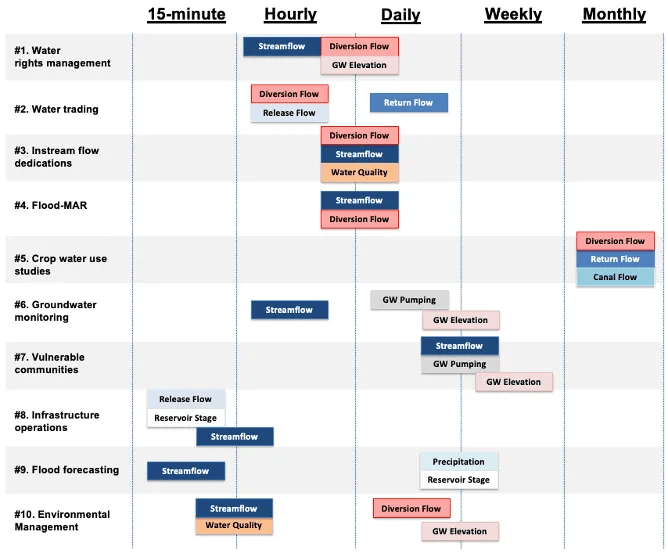
The TAC agreed that clear telemetry use cases could help demonstrate the value of telemetered data and clarify how it can support real-world decision making, particularly at the local level. The committee developed 10 use cases showing how telemetered data could inform decisions across a range of water management activities.
For example, implementing flood managed aquifer recharge (Flood-MAR) requires a permit to divert floodwater, but confirming water availability and impacts on other water rights can take so long that the flood flows are gone before they can be used. Telemetered data could give permit applicants a timely, data-driven picture of system flows while helping the State assess water availability for recharge.
The TAC examined the datasets needed for each use case and found substantial overlap in the types of data required. For example, high-frequency streamflow data are needed for eight of the 10 use cases. The TAC also discussed how quickly those data actually need to reach decision makers and noted that real-time data are not necessary in every case (see figure below). This distinction is critical for prioritizing telemetry investments: Where will more frequent, timely data provide the greatest value, and where might less frequent or delayed information suffice?
Better Data Is Everyone’s Responsibility
Collecting the data needed to support better water management is not always straightforward, particularly when the responsibility falls on individual water users. Although water measurement regulations were enacted more than 10 years ago, compliance remains low. Even when data are submitted, inconsistent units, formatting errors, and incompatible file types can limit their usefulness.
It may be tempting to blame water users for poor data quality or low reporting rates, but several complex factors are at play. Compliance is closely tied to trust: Do water users believe their data are secure and necessary for better decision making, and that the data will be used appropriately? Compliance may also depend on understanding of the technology, the cost of equipment and installation, access to technical support, and other factors.
The TAC developed several actionable recommendations that go beyond instructions and templates to improve the accuracy and availability of reported data. For example, the TAC recommended exploring basin-specific thresholds for frequent water-use reporting and recommended the State develop compliance and performance metrics to track and share how those data are applied in decision making. The TAC also recommended that the State Water Board conduct a comprehensive assessment of the costs and benefits of telemetered data and determine where collecting, managing, and using it provides a cost-effective return for water management objectives.
This matters because asking for more data burdens water users. For some, the perceived costs—including time, resources, equipment, and the potential for regulatory exposure—may outweigh the perceived benefits, particularly when the value of better data is not immediately apparent at the local level. The TAC identified ways to help bridge this gap, make telemetry more practical for water managers and water rights holders, and bring more value to local decision makers. Ideas include facilitating regional collaboration, adopting guidelines and procedures for equipment management, expanding training and services, and establishing standardized reporting requirements.
These recommendations rest on the reality that improving the quality and quantity of submitted data is not the sole responsibility of any one group. Everyone has a role to play in building a data system that is accurate, trusted, and useful for decision making.
The Governance Needed to Make Telemetry Work
Strong data governance is a critical feature of any monitoring program – not only to ensure data are accurate, accessible, and usable, but also to build trust in both the data and in the people who collect and manage them.
The TAC recommended a standardized data governance structure to enable interoperability across datasets and integrate effectively with State data systems. It would include clearly defined data management roles and responsibilities, a system architecture to simplify data processing and improve data availability, minimum data output requirements, a statewide quality assurance and quality control (QA/QC) framework, and guidance for using provisional data.
The distinction between provisional and final data emerged as particularly important in addressing concerns about the appropriate use of real-time data. As the use cases showed, many operational decisions, such as flood forecasting and real-time reservoir operations, require high-frequency local information. At the same time, water users and rights holders need assurance that provisional data will not be used prematurely or in ways that could have unintended regulatory consequences. The TAC concluded that State agencies need a clear, transparent framework for distinguishing how provisional and final data are used. This is fundamental to building trust: When people can see what data are being used, understand how those data are being evaluated, and know how provisional information may influence decisions, they are more likely to trust the system.
What’s Next?
The TAC’s discussions are only a starting point for the conversations and evaluations needed before additional real-time data are mandated or expected. Some of that work is already underway. The State Water Board’s Russian River Telemetry Study is exploring questions about telemetered water monitoring, including assessing costs and equipment quality, developing QA/QC practices, and addressing many of the challenges of collecting and sharing near real-time data.
The TAC recommendations build on these efforts and provide the State Water Board with actionable next steps:
- Identify high-value use cases for water users
- Articulate a clear technical roadmap
- Build interoperability across agencies
- Ensure that telemetered data are used to create shared value
Taken together, these steps can help California move toward a truly integrated, data-driven approach to water management that supports both human and environmental uses.

Front row, left to right: Daniel Siegel, Alex Beiring, Alison Rickard, Richael Young, Lucy Andrews, Greg Gartrell, Lauren Steely. Second row, left to right: John Sabo, Glen Low, Nicholas Markevich, Kirk Klausmeyer, Todd Schram, Chandra Chilmakuri, Rebecca Pluche, Kyle Knutson, Thomas Ott, Peter Kiel, Sonya Milonova, Robyn Grimm. TAC members not pictured: Brett Baker, Kaitlyn Chow, Teresa Connor, Stephen Ho, Kyle Onda, Cathy Ruhl, Laljeet Sangha, Beth Salomone, Alison Whipple.
About the Author
Sonya Milonova is a Senior Program Manager for the California Water Data Consortium, working on the Telemetered Data Project.
Prior to joining the Consortium, Sonya worked with international NGOs to deliver water, sanitation, and hygiene (WASH) services in protracted emergencies. Sonya worked as a project manager and technical advisor to increase community engagement, inclusion, and ownership in WASH programs, with a focus on prioritizing feedback from affected communities and using data to adapt programming. She led several technical working groups to support inter-organization learning and coordination and authored a handbook to provide practical guidance for practitioners delivering water and sanitation services in protracted emergencies. Sonya has also managed research projects to test novel public health approaches in limited resource settings.
Sonya holds an M.S. in environmental engineering, with an emphasis on engineering for developing communities, from the University of Colorado at Boulder.
Contact information: smilonova@cawaterdata.org
Leave a Reply