
By Peter B. Moyle


“Agriculture has claimed and taken away our former fishing conditions and we have but little water left for fish life within reach of the common people.” ~S.L.N. Ellis, 1922.
“When nature provides more water than storage facilities can handle, the lake will rise like a soggy Phoenix from the supine countryside -geography reasserting itself.” ~Gerald Haslam, 1989.
Introduction
Imagine spring sunrise on a vast lake in the southern Central Valley. The lake is surrounded by dense green tule marsh. The air is filled with a cacophony of sounds from calling blackbirds, singing marsh wrens, honking geese, and chattering ducks. Organized flocks of white pelicans and black cormorants are capturing the abundant fishes from the lake: thicktail, hitch, blackfish, Sacramento perch, pikeminnow, sucker. Many of the larger fish have just returned from their spawning migrations up the inflowing rivers and are feeding hungrily on abundant plankton, shrimp, insect larvae, and juvenile fish. In the shallows, herons and egrets stalk frogs and other prey, while otters and beaver swim busily around them, each otter occasionally diving to grab a mussel from the bottom, which it eats with a crunch at the surface. Tule elk emerge from the willow thickets to drink the lake’s water and to graze on the greenery. Integrated into this abundance of life are bands of the Yokuts people, perhaps 19,000 people in all, who live along the lake shore, moving back and forth from higher ground as lake levels rise and fall with the seasons and years. They harvest fishes, turtles, frogs, and birds from boats made of the buoyant stems of tules.
The Yokuts bands not only are harvesting fishes from the lake, but also from the rivers when pikeminnow, suckers, hitch and other native species make upstream spawning migrations. In many years, spring-run Chinook Salmon and Steelhead also spawn in the Kings River and are harvested by Yokuts bands who visit the river on a regular basis (Yoshiyama et al. 2001).

This vast aquatic ecosystem was paradise to the people who lived there for thousands of years, but it disappeared in a geologic blink of an eye following the arrival of Euro-Americans into California. The invaders wiped out the Yokuts peoples and drained the lake, gaining temporary farmland. We can get only glimpse of the lives of the Yokuts from archaeological sites (Gobalet and Fenega 1993), from the accounts of early ‘explorers’ and settlers, and from retrospective interviews of surviving natives. Perhaps the most remarkable of these accounts was from Thomas Jefferson Mayfield. As a boy, he was left by his father in the care of the Choinumi Band of the Yokuts, who were still living along the lake (1850-1862). His recollections (Mayfield 1928) provide a unique perspective of how the richness of life around the lake was central to the Yokuts culture, which included diverse methods to harvest fishes and turtles.
Lake Tulare
What made Lake Tulare such a special place? First, it was a large (‘the largest lake west of the Mississippi River’ according to accounts) and a permanent feature of the historic landscape. It was located in a low spot in the southern Central Valley that was underlain by layers of impermeable clay. This meant water accumulated there, leaving only by evaporation or by overflow. The latter happened during extreme wet years when the lake overflowed into the San Joaquin River, via Fresno Slough.
Second, it was maintained by run-off from the high southern Sierra Nevada, which filled the lake with snow-melt via the Kings, Tule, Kaweah and smaller rivers. The lake usually covered about 650-700 square miles, with water in some parts of the lake up to 25-35 feet deep. The lake would have been bigger after a series of wet years and smaller during a period of extreme drought, although even during drought years there likely would have been some run-off into the lake. During wet years, Lake Tulare would have connected with Lakes Buena Vista and Kern to the south, fed by the Kern River and to Summit Lake to the north, which connected to the San Joaquin River.
Third, due to high evaporation, the water would have been somewhat alkaline during drier periods. This would have enhanced the lake’s ability to support abundant life, especially fish production. Evidence for this is shown by the tolerance for high alkalinities found in native California fishes that were abundant in the lake, such as Sacramento perch.
Demise of the Lake and its people
How did Lake Tulare become a disappearing act? It largely started with the Gold Rush and the sudden arrival of thousands of entrepreneurs, thinking to get rich quick, and having no problem engaging in genocide on the Yokuts people. The Yokuts had barely survived an earlier drastic reduction of their numbers by smallpox, malaria, and other European diseases, with a major epidemic in 1833. While the federal government claimed the lands of California once it was annexed, the new state government was delegated responsibility for selling ‘vacant’ lands, including tribal lands. These lands included the ‘swamp and overflow’ lands of the Southern Central Valley, which could be purchased for pennies if the purchasers could demonstrate the land could be crossed in a boat and that they had a willingness to drain it for farming. The new owners of the land underneath Lake Tulare were soon at work attempting to keep it dry using an ingenious system of levees, diked fields, and drains (Haslam 1969). In addition, dams were built in the mountains to retain melt waters feeding the Kaweah, Tule, and Kings rivers. Part of the drainage activity was to enlarge and deepen Fresno Slough, the natural exit for flood waters.
All these measures, combined with luck on the weather, dried up the lake so the lake bed could be farmed, and ironically, irrigated with the water that used to fill the lake. With the drying, all hope was lost that the Yokuts might be able reclaim their own ancestral home areas, not that anyone cared what happened to them at the time. One of the unforeseen consequences of the improved connection to the San Joaquin River was the development of Chinook salmon spawning runs up the adjacent Kings River in the 1920s, 30s, and 40s (Moyle 1970). Another unforeseen development as the lake was drained was the loss of the commercial sailboat fishery that supplied the markets of San Francisco with turtles, fish, and frogs.
Through the first half of the 20th Century, the farmers in the Tulare Lake Basin, mostly a handful of mega-farmers such as J.G. Boswell, continued the fight to avoid having Lake Tulare rise again. The farmers had sufficient clout with the federal government that they could get the Army Corps of Engineers to spend millions of dollars building Pine Flat Dam on the Kings River as a flood control structure; the dam was completed in 1954 at virtually no cost to the farmers. Similar flood control dams were soon built by the Corps on the Kaweah, Tule, and Kern Rivers. It did not matter that the principal area being protected from flooding was a drained lake. These shenanigans and others are described in detail by Reisner (1986), Arax and Wartzman (2005), and Arax (2019).
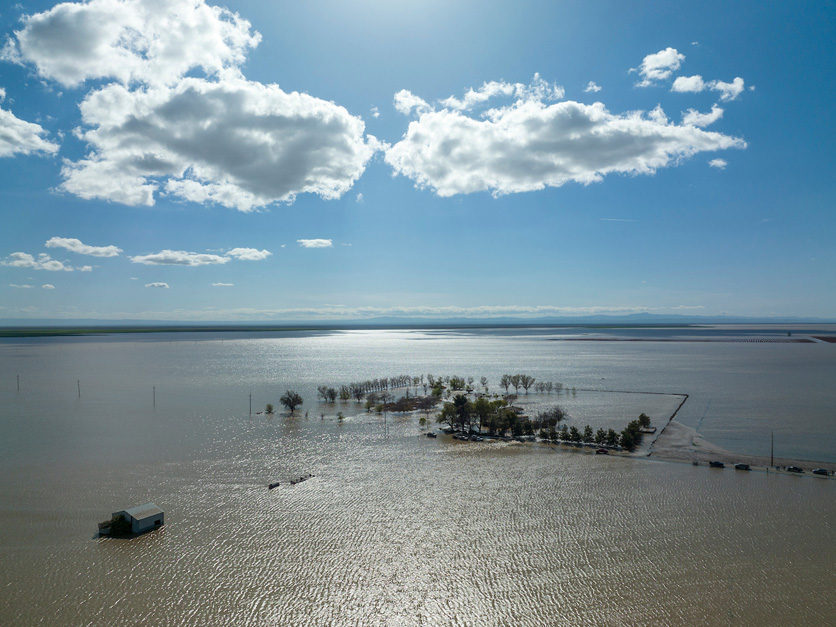
According to the values of the times, growing huge acreages of cotton, alfalfa, tomatoes, and other row crops was much more important than having a navigable lake with abundant fish and wildlife that could be harvested. Even today, the biggest concerns over the predicted meltdown of the record southern Sierra Nevada snowpack focus on economic losses to farmers and damage to houses and other infrastructure from the predictable return of water to the lake basin (Karlamanagla and Hubler 2023). A major problem with the ‘flood’ flows into the Lake Tulare basin is that they occur infrequently and erratically, making them easy to forget.
Return of the lake
Despite all the efforts to keep Lake Tulare’s bed dry, snowmelt from the mountains overwhelmed the drainage system in 1969, 1983, and 1997. The lake returned each time, and with it, fishes from reservoirs and ditches. The 1983 event was particularly memorable not only for its size but because of a new problem, the illegal introduction of white bass into Kaweah Reservoir (Lake) (Moyle 2002). This fish species, native to the eastern USA, thrived in its new home, as a voracious schooling predator on small fish and was much prized by anglers. The California Department of Fish and Game (CDFG) had originally been responsible for bringing the bass into the state, introducing it into Nacimiento Reservoir on the Salinas River, in 1965. However, the illegal establishment of white bass in Kaweah Reservoir was regarded with alarm, for fear it would invade the Delta and severely hurt the popular fishery for striped bass – another introduced species, but also populations of salmon, sturgeon, and other native fishes. White bass thrived and reproduced in the emerging lake. When pumping began it seemed that the invasion threat would be realized. Screening the pump intakes was tried but quickly abandoned. After many months of pumping, draining of the lake was completed. In 1987, CDFG then embarked on a campaign using rotenone (a fish poison) to eradicate white bass from the Tulare and San Joaquin basins (Dill and Cordone 1997). CDFG first poisoned Kaweah Reservoir, then systematically poisoned ditches and sloughs that might contain bass. This was the largest fish poisoning operation ever attempted by CDFG, and to my amazement, it was successful. As a result, white bass do not live in the Delta. This story indicates that with floodwaters, unexpected events can happen that go beyond standard flooding issues, such as spread of diseases and alien species and blooms of toxic algae. It also demonstrated that fish populations develop quickly once water fills the lake bed again.

Future prospects
Following the motto that ‘You Can’t Keep a Good Lake Down,’ Lake Tulare last emerged again in 1997 but was soon drained. Now (April, 2023), the lake is already starting to re-emerge and a record snow pack in the southern Sierra Nevada ensures that Tulare Lake will come back bigger than ever in the next few months. Climate change predictions indicate that such events are likely to become more frequent, followed by record droughts (Mount 2023). Perhaps the time has come to let Lake Tulare and its surrounding marsh lands return to their more natural state. The clay bowl of the original lake bed can hold water for years, recreating habitat for migratory ducks and geese and other wildlife. Over-pumping of groundwater from the Tulare Basin during years of drought has resulted in subsidence of the lake basin, further increasing its capacity to hold water (Mount 2003). Fish will come in with the water, and native species such as Sacramento blackfish and hitch, as well non-native species such as common carp, largemouth bass, bluegill, and Mississippi silverside will establish populations to form the basis for renewed fisheries and a renewed ecosystem. Perhaps the well-developed tradition of manipulating levees and drainage ditches in the basin can be used to maintain a somewhat smaller version of the lake (but much more than just a pond for evaporation of contaminated farm drainage water) and its marshes. This might allow the lake to persist even during extended droughts, when no dam-releases of water are available from the normally inflowing rivers. Restoring even some part of what was once the largest lake west of the Mississippi River, and its fishery, would be an astonishing accomplishment! Perhaps there will be a spring day in the future when the scene I imagined for Tulare Lake returns in some fashion and the lake is once again alive with life, including native plants, birds, mammals, turtles, and fishes.
Some questions
Under the Public Trust Doctrine, how could a navigable lake that supported fisheries (including the Yokuts’ fishery) be turned into private farmland? How did Lake Tulare come to be owned by white settlers, so it could be drained? To the best of my knowledge, the lake was historically a permanent feature of the landscape, maintaining its water even during severe droughts. Now, as the lake arises again, the same question persists: why is it legal to drain Tulare Lake for private gain? And shouldn’t the descendants of the Yokuts bands who had their lake and lands stolen from them have something to say about what happens to their ancestral home? Is Nature is telling us that a new Lake Tulare paradigm is needed, featuring the return of the lake to a more natural ecosystem?

https://www.agri-pulse.com/ext/resources/California-Bureau/Tulare-Lake-flooded-farmland-836×627.jpg?1680694088
Acknowledgments
This blog was inspired by a recent conversation I had with Garrick Chan, who asked me the above questions. Comments by Jeff Mount, John Durand, and others improved the blog.
Further reading
The article in Wikipedia is excellent reading and is recommended as a good starting place for those who want more information about the lake and its history, including the terrible treatment of the native peoples.
Arax, M. 2019. The Dreamt Land: Chasing Water and Dust Across California. Alfred Knopf. New York, NY.
Arax, M. and R. Wartzman, 2005. The King of California: J. G. Boswell and the making of a secret American empire. Perseus Books.
Dill, W.A. and A. J. Cordone. 1997. History and Status of Introduced Fishes in California 1871-1996. California Department of Fish and Game Fish Bulletin 178. Sacramento.
Ellis, S.L.N. 1922. Bits of history of Tulare Lake fishing. California Fish and Game 8:206-208.
Gobalet, K.W. and Fenenga, G.L. 1993. Terminal Pleistocene-Early Holocene fishes from Tulare Lake, San Joaquin Valley, California with comments on the evolution of Sacramento squawfish (Ptychocheilus grandis: Cyprinidae). PaleoBios15(1):1-8.
Haslam, G. 1989. The lake that will not die. Pacific Discovery. Spring 1989: 28-40
Karlamanagla, S. and S. Hubler. 2023. Lake that was drained wreaks revenge in a California valley. New York Times, Section A (p. 1). April 3, 2023.
Mayfield, T.J. 1928. Indian Summer: Life Among the Choinumi Indians. Reprinted by Heydey Books, Berkeley CA.
Mount, J. 2023. Epic snowpack may test water management in San Joaquin Valley. Blog, Public Policy Institute of California. March 13, 2023.
Moyle, P. B. 1970. Occurrence of king (Chinook) salmon in the Kings River, Fresno County. California Fish and Game 56:314-315.
Moyle, P.B. 2002. Inland Fishes of California, Revised and Expanded. University of California Press. Berkeley, CA
Reisner, M. 1986. Cadillac Desert, The American West and its Disappearing Water. Penguin Books. New York, NY.
Rypel, A.L. 2021. Defending ‘rough fish’. https://californiawaterblog.com/2021/12/19/defending-rough-fish/
Sheehan, T. 2023. Tulare Lake may take more than a year to recede. Sacramento Bee 1C, 2C. March 26, 2023.
Yoshiyama, R. M., E. R. Gerstung, F. W. Fisher, and P. B. Moyle. 2001. Historical and present distribution of Chinook salmon in the Central Valley. Pages 71-176 in R. Brown, ed. Contributions to the Biology of Central Valley Salmonids. CDFG Fish Bulletin 179. https://escholarship.org/uc/item/6sd4z5b2


Leave a Reply