Resilient California Fishes: Tule Perch

By Peter B. Moyle and Tom L. Taylor

This is the second blog in a series on native California fishes that seem to be doing well despite multiple threats. They are still common and widely distributed, despite major changes to their habitats. The Tule Perch (Hysterocarpaus traskii) is an interesting species to include in this series because it contains three distinct subspecies, two of which seem to be doing well and one that is not. The first, Sacramento Tule Perch (H. t. traskii), has lost some habitat in the Sacramento River system (e.g., San Joaquin River on the Valley floor) but is still common in the main rivers below dams and has also colonized “new” habitats where they can be abundant (e.g., hydropower reservoirs). The second, Russian River Tule Perch (H. t. pomo), is widespread and abundant in the river and may have benefited from water projects that increased summer flows (Cook et al. 2010). The third, Clear Lake subspecies (H.t. lagunae), appears to be scarce in the lake, in contrast to the 1970s when we sampled the lake and found Tule Perch to be fairly common. See our first blog in this series for an explanation of how species were chosen as examples of resiliency.

Revisit this tag to see other blogs in the Resilient California Fishes series as they are posted.


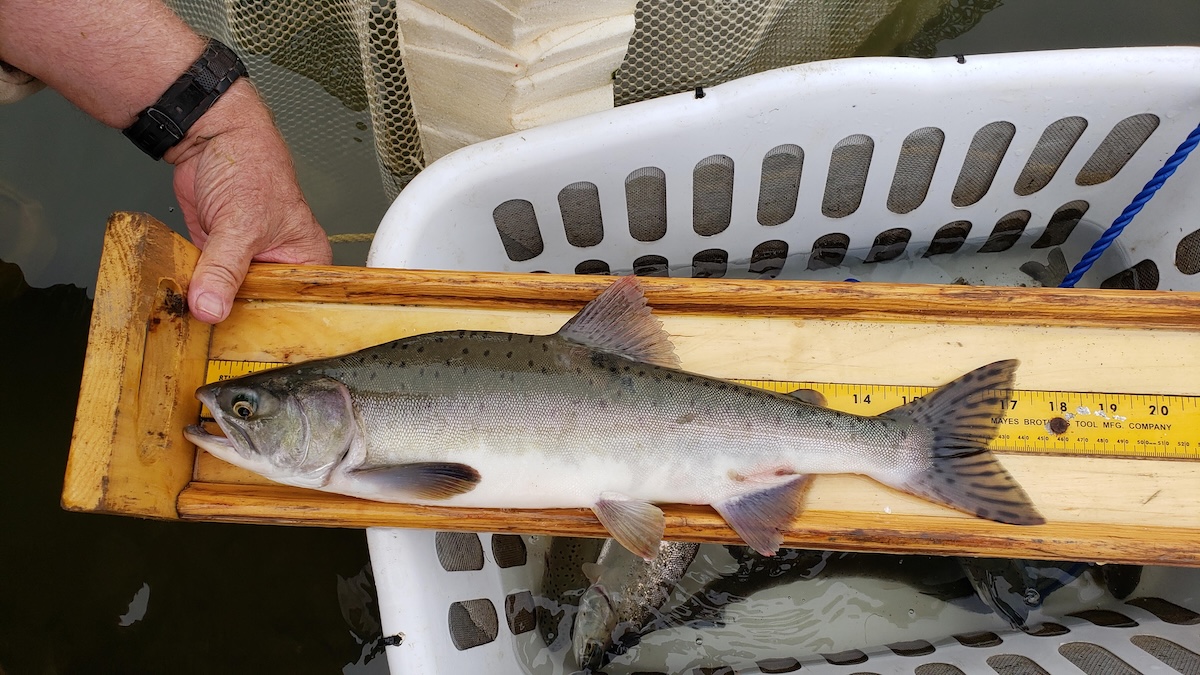
Figure 1. Tule Perch captured in hoop nets set in Lindsey Slough, a channel off of Cache Slough in the North Delta, in October of 1979, showing the varying color patterns of barred, unbarred, and white or yellow bellies. Photo by Tom Taylor.
Figure 2. Tule Perch in Putah Creek demonstrating their dependence on complex cover, as well as their social nature. Photo by Juan Cervantes.

Introduction. Tule Perch are attractive little fish (adults less than 20 cm long) that are endemic to Northern California. They are the only freshwater fish species in the surfperch family (Embiotocidae). This family is made up of 22 marine species plus Tule Perch, mostly from north Pacific Coast habitats. The surfperches gained attention as early as the Gold Rush era because they are viviparous (live-bearing), an unusual trait in spiny-rayed fishes. In 1854, they became the very first freshwater fish species formally described from California, by a physician, beating out several other species described in the same newspaper in the same year (Evermann and Clark 1931). Tule Perch bodies are thin and almond-shaped, with a small, hard mouth adapted to picking or sucking up small invertebrates and then crushing them with flattened pharyngeal plates in the throat. The perch comes in a variety of color patterns: white or yellow bellies and barring on the sides that are narrow, wide, or even absent. 

Figure 3. Newborn Tule Perch from the Russian River. Photo by David Cook.

Distribution and Taxonomy. Tule Perch are widespread in central California, with three distinct geographically-defined populations: Russian River, Clear Lake, and Sacramento River and tributaries. These three populations are isolated from one another and are regarded as separate subspecies, with distinct life histories (Hopkirk 1973, Baltz and Loudenslager 1984). The Russian River Tule Perch is abundant and widespread in a coastal river that has historically had wide fluctuations in flow, which, when very low, greatly limited habitat. The year-to-year uncertainty of river habitat caused the perch to develop a life history to deal with this variability. The fluctuations led to high mortality rates in many years, so the fish evolved to be mature at a small size and reproduce at higher levels. Thus, females have high fecundity, giving birth to 12-45 tiny young in their first year of life. They rarely live more than two years. It is likely that Russian River Tule Perch have benefited from the construction of two large dams, which release water into the river in summer, reducing variability in flows (Cook et al. 2010). 

In contrast, Clear Lake and Sacramento Tule Perch live three to eight years and do not start breeding until their second year. Each female produces 25-60 young, the number increasing with size and age. Sacramento Tule Perch occur in a wide variety of habitats, including turbid sloughs of the Delta and Suisun Marsh, the main Sacramento River and tributaries, and Britton Reservoir on the Pit River (Moyle 2002).

Figure 4. Female captured while giving birth in Suisun Marsh. Photographer unknown.

Tule Perch are small, deep-bodied, spiny-rayed fish that are viviparous (live-bearing), with females giving birth to 10-60 young each year. The number and size are related to the mother’s body size, age, and habitat. They favor cool water habitats in low gradient reaches of rivers where there are deep pools that have rock walls or boulders and/or complex vegetative cover. The cover consists of branches that have fallen from riparian trees, as well as cover created by riparian vegetation that hangs into or over the water, or from floating aquatic vegetation. The key here is that such habitats need to provide complex cover for pregnant females and newborn young. The young are precocious, so they swim away as soon as they are born, mostly in May or June. The males grow fast and mate with females by September. Females also grow rapidly and store sperm from mating with multiple males until used for fertilizing the eggs, usually in January. This unusual trait presumably evolved to protect them from predators, allowing the perch to thrive in diverse habitats, including estuaries, seasonal rivers, lakes, and reservoirs. They are generally found in habitats that have high water quality, featuring cool, clear water in rivers and lakes. However, they are also found in turbid water, such as is found in Suisun Marsh and other parts of the Sacramento-San Joaquin Delta. 

Figure 5. Tule Perch in the Russian River below Healdsburg Dam in August of 2002. Invertebrate prey inhabit the large boulders and are also found in the filamentous algae. Photo by Tom Taylor.

Diet. Tule Perch feed on abundant benthic invertebrates and zooplankton. It was surprising to us to watch the perch foraging in flowing waters, because their deep bodies would seem to make it difficult for them to hold in place to forage on the bottom and other substrates. However, they are in the surfperch family, and marine species of that family often occupy turbulent habitats in the surf zone. These fish propel themselves with the use of their pectoral fins and use their small caudal fin for steering. The pectoral fins are used to effectively row themselves through the current. In Suisun March and the Delta, they mainly feed on abundant amphipods (Corophium), both native and non- native species. In Clear Lake, they feed mainly on zooplankton and aquatic larvae of midges and gnats. The diet is similar in the Russian River, where they feed on a variety of aquatic insects found in or on the benthos and on aquatic plants. Basically, Tule Perch eat whatever small aquatic invertebrates are abundant in their habitats. The presence of Tule Perch bones in middens of Indigenous people indicates they were consumed at times, despite their small size. 

Figure 6. A school of juvenile Tule Perch taken in July of 2005, swimming in a side-channel pool of the Lower American River near Sunrise Avenue. Photo by Tom Taylor.

Resiliency. The different life history patterns of Tule Perch has allowed them to live in altered habitats that also support non-native fishes. Their deep bodies, spiny fins, viviparity, and use of complex cover presumably discourage predators. The ultimate test of their resiliency was the attempt by CDFG in the 1950s to poison, with rotenone, all fish in 460 km of the Russian River and tributaries to favor steelhead. It was assumed that the diverse community of fishes in the river was somehow suppressing the steelhead population. The poisoning was a failure, although thousands of fish were killed, including Tule Perch and other native fishes. The Tule Perch population recovered in just a few years (Cook et al. 2010).

Figure 7. Tule Perch inhabit the channel edges of the Lower Russian River at Casini Ranch, where beds of floating aquatic vegetation provide cover and feeding habitat. Photo by Tom Taylor, August 2019.

Conclusions. Tule Perch favor cool water habitats in low gradient reaches of the rivers where there are deep pools with lots of vegetative structure in the water, and they also occupy areas with boulders and underwater rock faces. Juveniles may be found in connected ponds on the floodplain in wetter years. They can also live in turbid waters associated with the Sacramento-San Joaquin Delta and in lakes and reservoirs. While the perch have overcome many human-caused changes to their habitats, there is no reason to be complacent about their long-term persistence; climate change will make the waters they inhabit warmer, smaller, and more variable, especially in Clear Lake. The resilience of Tule Perch will be severely tested in the coming years, so monitoring populations of the three subspecies should be formalized. The Tule Perch is a remarkable species, unique to California, so it deserves attention. 

FIgure 8. A pregnant female tule perch (top), with her recently-birthed offspring (bottom). This fish was found May 2011 at Liberty Island, a flooded-agricultural tract in the northwest San Francisco Bay Delta. Tule perch do not lay eggs, but instead give live birth. The U.S. Geological Survey (USGS) studies native species like this to evaluate the importance of tidal wetlands to native fishes. Photo by USGS. Sources/Usage Public Domain.

About the Authors

Peter Moyle is Distinguished Professor Emeritus at the University of California, Davis, and is Associate Director of the Center for Watershed Sciences.

Tom Taylor has had a long career as an agency and consulting biologist, often working with native fishes. He has also taken underwater photos of many of the fishes, which will illustrate the blogs.

Further Reading

Baltz, D. M., and P. B. Moyle, 1981. Morphometric analysis of tule perch (Hysterocarpus traski) populations in three isolated drainages. Copeia 1981: 305-311.

Cook, D.G., S. D. Chase, and D.J. Manning. 2010. Distribution and ecology of the Russian Tule River Tule Perch. California Fish and Game 96(2):146-164.

Baltz, D. M., and P. B. Moyle. 1982. Life history characteristics of tule perch (Hysterocarpus traski) populations in contrasting environments. Environmental Biology of Fishes 7: 229-242 

Gobalet, K. W., P. D. Schulz, T. A. Wake, S. N. Siefkin, 2004. Archaeological perspectives on Native American fisheries of California, with emphasis on steelhead and salmon, Transactions of the American Fisheries Society 133: 801–833. https://doi.org/10.1577/T02-084.1

Hopkirk, J. D. 1973. Endemism in Fishes of the Clear Lake Region of Central California. University of California Publications in Zoology 96:1-160.

Moyle, P.B. 2002. Inland Fishes of California, Revised and Expanded. Berkeley, University of California Press.

Pintler, H. E., and W. C. Johnson. 1958. Chemical control of rough fish in the Russian River Drainage, California. California Fish and Game 44(2) 91-124.

Vondracek, B., D. M. Baltz, L. R. Brown, and P. B. Moyle. 1989. Spatial, seasonal, and diel distribution of fishes in a California reservoir dominated by native fishes. Fisheries Research 7:31-53.

Posted in Uncategorized | Tagged , , , , , , | Leave a comment

Three Generations of Stewardship: Exploring the Legacy of Environmental Protection on Putah Creek

By Petrea Moyle Marchand

This is a cross-post from a blog featured on Consero Solutions.

After the indefinite cancellation of school at the start of the Covid-19 quarantine, my Dad, Peter Moyle, offered to teach my kids about Putah Creek. A fish biologist and University of California, Davis professor who started studying the creek during his early years at UC Davis in the 1970s, there are few people in the world who know as much about the creek. “Sure!” I responded enthusiastically, without asking the kids. Putting down the phone, I turned to Cam and Romy, age 13 and 11, with a stern look to tamp down any resistance. “You’re doing science lessons with your grandfather. And there will be homework. You’re going to participate and work hard.” Neither Romy or Cam are scientifically inclined, so my directive resulted in the expected resigned looks and sighs. I was briefly reminded of my own childhood antipathy to long hikes and unwanted nature lectures, once even lying down in protest across a trail. Given how much I appreciate those experiences now, it was easy to ignore my kids’ complaints.

Years ago, when I asked my father about his greatest achievement, he responded he was proudest of his work to help restore Putah Creek. His answer surprised me, given he’s internationally known for his textbooks and his research on California freshwater fishes. He has testified in lawsuits to restore river flows, published hundreds of papers, and contributed to Endangered Species Act listings of native fishes in decline. Putah Creek is a small California waterway walking distance from my parents’ house. It travels 85 miles from its headwaters in the Coast Range to the Yolo Bypass, where any remaining water flows into the Sacramento River and eventually into the ocean. The creek is dammed twice, to provide flood protection and water supply. The lowest dam is the Putah Creek Diversion Dam, above the City of Winters, which siphons off water for Solano County cities and farms. The creek then winds its way through agricultural fields, and finally skirts the City of Davis. This small creek is my Dad’s choice as the highlight of a life of conservation work?

The first science lesson with the kids focused on learning about the birds which call Putah Creek home and an introduction to important terms, such as “riparian habitat,” “endemic,” and “non-native.” The kids dutifully read off the answers from their homework assignments, with various levels of accuracy, and tried to identify the birds my Dad pointed out. They learned endemic means a plant or animal unique to a particular region, non-native means a species native to somewhere outside of this region, and riparian habitat refers to habitat adjacent to a waterway important to many animals. They learned how white settlers, who mostly arrived after the 1849 Gold Rush, transformed wide swaths of riparian forest into mere slivers of trees and plants lining the streams which today support only a fraction of the original bird and animal populations.

One day, we counted 18 western pond turtles sunning themselves on tree branches sticking out of the water, which the kids named “The Log of the Swimming Turtles.” I grew up visiting the creek, but I was astounded by how much I did not know. My Dad’s unassuming lectures and patient questions revealed a natural world few people notice; western bluebirds peeking out of nest boxes, black phoebes swooping over the creek to grab aquatic insects, tree swallows flitting over nearby agricultural fields, mockingbirds singing from their oak tree perches, and pairs of Swainson’s hawks flying high above in the blue sky.

Abandoned cars in Putah Creek above Pedrick Road Bridge, circa 1991 (left) and 2003 (right).

When my Dad arrived at the UC Davis campus in 1972, the University mined Putah Creek for gravel, people used it as a dump site (including old cars and washing machines), and state agencies cleared the vegetation for flood control. My Dad’s first visit to the creek resulted in the disappointing conclusion, “There’s nothing to sample here.” And in particular, there were few native fish because much of the stream was dry. My Mom remembers signs warning people not to use the creek because of contamination. Six months pregnant with me, she made a mental note to keep her kids away from the creek.

ree
Stagnant water in the now South Fork Preserve prior to conservation, circa 1980. The City of Davis restored this stretch of Putah Creek and associated habitat in the 1990s with funds from the voter-approved open space parcel tax.

The next few science lessons involved teaching the girls about the cultural history and geomorphology of the creek, as well as continued bird identification and aquatic insect sampling. They learned about the native Patwin people who once lived everywhere in the watershed, the impact of building the Monticello Dam on natural flooding, and the incision of the creek’s corridor as a result of levees that prevent water from flowing freely onto nearby fields and meadows. The best student of my Dad’s teachings turned out to be my husband Vince, who quickly picked up on bird’s names and would stare intently into the trees until a bird emerged. After a particularly interesting lesson, we reported on the sightings to our 22-year-old daughter Maddie, home for the summer. “You’re all bird nerds,” she laughed. “True,” I thought. “We are. Who knew.”

ree
My Dad and Romy sampling for aquatic insects near the Pedrick Road Bridge, July 2020. 

Despite my Dad’s uninspiring first visit to the creek, he supported student fish research projects on Putah Creek in the 1970s and started taking his fish class to sample the creek in 1976. Towards the end of the decade, he and other university scientists joined with professor Kerry Dawson, to ask the University to stop mining the creek and instead create a riparian reserve. Surprisingly, university leaders agreed and mining quietly stopped. Some urgency was added to my Dad’s advocacy by my brother Noah, who in the early 1980s was old enough to ride his bike with his friends to Putah Creek to swim during the summer. Much to my Mom’s horror, the boys liked to jump off a bridge on Old Davis Road into a pool fed by discharge from the University’s wastewater treatment plant. My Dad understandably decided kids should have alternate places on the creek to swim. 

ree
University gravel mining site and Pedrick Road Bridge construction, circa 1974.

UC Davis hired recent graduate Steve Chainey to create and manage the new Putah Creek Riparian Reserve in the early 1980s. In 1988, Steve and his colleague Susan Sanders formed the nonprofit Putah Creek Council with other local luminaries such as Robin Kulakow and Bill Julian, marking the start of decades of work to restore the creek. The culmination of the Council’s work was a lawsuit filed in 1990 and settled in 1996, for which my Dad volunteered as an expert witness. The settlement required Solano County’s water agency to restore flows to Putah Creek, established a Putah Creek streamkeeper position, and contributed to over $12 million in grants to restore the creek over the next 15 years.

As a result of the Council’s lawsuit and decades of clean up and restoration work, the creek now flows with clear water, has lush riparian vegetation, and hundreds of salmon miraculously resumed spawning every fall after disappearing for decades. It is not a natural creek by any means; the creek is much altered by diversions, levees, and other human modifications. And it is still only a sliver of the habitat the creek originally provided for native species. But people who once avoided the creek now flock to it, floating downstream in inner tubes, tying ropes to trees to jump into deep pools, hiking on new trails, letting their dogs and children play in the clear, clean water. Unthinkable 40 years ago when people avoided the creek because “there was nothing there,” now overuse is contributing to erosion, trash accumulation, and other impacts that require constant vigilance and expenditures of large sums. And birds, turtles, coyotes, and other creatures have a small strip of refuge from less hospitable land uses.

ree
Illegal swings over the creek in the UC Davis Riparian Reserve with associated erosion in 2020; abandoned inner tube in the background.

The science lessons continued throughout the pandemic. Sometimes the kids’ attention turned to picking blackberries or shimmying up a tree to pluck bunches of wild grapes, so my Dad gracefully paused the lessons. Sometimes the kids’ grumpiness at waking early required bribery with ice cream or popsicles. But I remember a time when I, too, rolled my eyes at my Dad’s efforts to educate me about nature and mightily resisted his entreaties to hike during hot Central Valley summers. Somehow, I absorbed the lessons he taught and the experiences he shared, albeit slowly and unwittingly, until they became a part of who I am. Now my curiosity is real and my dedication to furthering conservation unshakable. Regardless of whether Cam and Romy pursue an environmental career, I hope my Dad’s lessons will help them remember a mighty few can make a difference in this world with hard work and perseverance. And as importantly, I hope they remember to tread lightly on this earth to help protect the voiceless inhabitants of the natural world; birds, fish, and animals who continue to suffer great harm from ignorant human actions.

About the Author

Petrea Moyle Marchand

Petrea Moyle Marchand is the founder and president of Consero Solutions, a social impact consulting firm focused on empowering local governments and nonprofits to improve people’s lives, strengthen communities, and protect the environment. With more than 30 years of experience working with organizations at the local, state, and national levels, Petrea helps translate complex challenges into practical, well-funded solutions with measurable community impact. 

Further Reading

For more information about Putah Creek, visit:

  • The Putah Creek Legacy — A five-part series published by The Davis Enterprise in 2004 that includes a chapter each on the 1980s drought, the Putah Creek Council, the lawsuit, the revival of the creek, and the future.
  • The Putah Creek Council’s Oral History Project — To celebrate the Putah Creek Council’s 25th anniversary, the Council interviewed nine early Putah Creek Council members, including my Dad.

ree
Romy and Cam during a “lesson” with blackberries smeared on their faces. July 2020.
Posted in Uncategorized | Tagged , , , , | 3 Comments

Where are they now: Dana Myers

“Where are they now” is a series on the California WaterBlog. The series will celebrate the many alumni who got their start at the Center for Watershed Sciences (CWS) and have now gone on to bigger and better things. Blog posts from the “Where are they now” series will be peppered throughout our regular blog line up, and they will highlight both former students and past employees of CWS. We hope you enjoy their stories in their own words!

Next up is Dana Myers, who was at CWS from 2017 – 2019.


I was just getting started in college as a bright-eyed college sophomore, ready to get hands-on experience in research, when I started working at CWS in January of 2017.

Dana Myers posing with a rainbow trout after participating in her first field work trip tagging these fish to track their migration throughout the Delta.

Working as an Undergraduate Researcher at the Center for Watershed Sciences (CWS), I got up close and personal with juvenile Chinook Salmon, extracting their gut contents to understand what they’re really eating. My job included being a part of the Bug Lab, the unofficial name of the lab created by Dr. Rachel Johnson and Dr. Carson Jeffres (JJ Lab), placing me diligently behind a dissection microscope squeezing out gut contents of juvenile Chinook Salmon. This research was led by Dr. Anna Sturrock (now back in the UK) and supported by Mollie Ogaz (now at Cramer Fish Sciences). In the end, this work culminated into a published paper on floodplain foodscapes and their influence on Chinook Salmon sustainability in the Delta. In addition to this research, at the end of my senior year, I teamed up with another researcher, Miranda Bell Tilcock, to present isotope research at the 2019 Interagency Ecological Program’s Conference.

Throughout my time at CWS, I worked full time at CWS every summer, which also meant that I was biking miles in the wonderful 100+ degree weather. As a southern California native, this heat was way outside the normal for me and I felt it every time I stepped into the sunlight. Whenever I arrived at the lab, I would be drenched in sweat. Miranda and Mollie would take one look at me and send me to the walk-in freezer (where we kept our samples) to cool off. Honestly, I wish for every job I have to have a walk-in the freezer; it was a game-changer.

Dana Myers posing with her first lead author poster at the 2019 IEP Conference in Folsom, CA.

Now I am a PhD candidate at the University of California, Santa Barbara, studying Physical Oceanography as a part of the Coastal Oceanography and Autonomous Systems (COAST) Lab. You can find me putting instruments out in marshes to measure water flow, flying drones over kelp forests to monitor their abundance, and teaching students about oceanography as both a teaching assistant at UCSB and as a naturalist for Santa Barbara youth through various outreach programs. 

My current research takes me back to the Delta and close to my CWS family! I am a 2025 Delta Fellow, studying saltwater intrusion in the San Francisco Bay-Delta using satellite remote sensing technologies. The Delta is a crucial part of California’s water system, but it has been heavily modified. Dams now control much of the freshwater release in the Delta to counter the saltier ocean water that enters the system from the San Francisco Bay. This balance of fresh and saltwater mixing influences water quality, habitat suitability, and freshwater management, yet comprehensive observations of its dynamics remains limited. This project uses a novel approach to bridge this gap in knowledge: examining satellite photos to track where fresh river and salty ocean waters meet. In particular, I’m focused on a zone known as the “estuarine turbidity maximum,” a cloudy band of muddy river water mixed with salty ocean water that is visible to modern satellites. This turbidity signature also tends to align with the “low salinity zone” used by regulatory agencies to mark the extent of saltwater intrusion. By relating turbidity and salinity in the Delta, I can assess whether the estuarine turbidity maximum can be used to indicate the extent of saltwater intrusion, offering a new tool for assessing freshwater outflow requirements from dam releases and ecological habitat extent under changing climate and water operations

Dana Myers and fellow 2025 Delta Science Fellow recipients at the Delta Early Career Workshop in Sacramento, CA. From left to right: Nishar Chhatiawala (RAND School of Public Policy), Sebastian Gonzales (UC Davis), Rebecca VanArnam (UC Davis), Shahin Islam (UC Davis), Dana Myers (UC Santa Barbara), Abhinav Sharma (UC Santa Cruz)

CWS was vital in getting me to where I am today. My first time in a research lab was at CWS, and I have held every subsequent research position I have had since to the standards that CWS set. I want a work place that is a fun place to walk into every day, fosters a friendly environment where coworkers are uplifting about your work and interested in your well-being, all the while being dedicated to performing meaningful research. 

I still use Rachel and Carson as my job references, and I think it’s an attestament to their investment in my career (professional, as well as, personal) that they can still speak on my character and work ethic even 6 years later.

About the Author

Dana Myers and fellow researcher Jordan Snyder (UC Santa Barbara) hand launching a large drone off the coast of Santa Barbara to study giant kelp abundance.

Dana Myers grew up in Long Beach, California and completed her Bachelor of Science in Environmental Science and Management with a minor in Geographic Information Systems at the University of California, Davis. On top of working for the CWS, she also interned for Dr. Amelia Munson at the Center for Aquatic Biology and Aquaculture studying fish metabolisms; Dr. Lauren Yamane in the Department of Ecology researching red urchin fishing pressures; and Dr. Sarah Yarnell at CWS demonstrating the benefits of beaver dams for carbon sequestration in meadows. She rounded off her time at UC Davis by studying abroad at the University of Queensland, St. Lucia in Brisbane, Australia taking terrestrial ecology and marine biology courses. This sparked her passion for marine science and she has since gone on to work for the California Department of Fish and Wildlife in their Marine Division, obtained a summer fellowship with the NASA DEVELOP program researching wetland inundation, and most recently, works as a Marine Science Ph.D. candidate at the University of California, Santa Barbara. When she is not diligently working on her dissertation, you can find her teaching children about marine science as an instructor at the Santa Barbara Maritime Museum or strolling through thrift stores and yard sales around Goleta, CA, or improving her art skills outside of cafes in the area.

Support experiences like this 

If this story resonated with you, consider making a gift to the Center to help us create more meaningful opportunities for students across our programs. Want to support the specific experience featured here? You can do that too, by supporting CWS Fishes, Floodplains, and Springs Research.

Dana Myers and fellow researcher Jordan Snyder (UCSB) calibrating drone equipment in preparation for field work off the coast of Santa Barbara.
Posted in Uncategorized | Tagged , | Leave a comment

Future Ancestors of Freshwater Fishes in California

By Peter B. Moyle

Smoky sunset over Eagle Lake, Lassen County, CA – home of endemic Eagle Lake rainbow trout and other endemic fishes and invertebrates. Sept 23, 2014. Will this terminal lake and its unique ecosystem survive global warming? This will be discussed in a future blog.

* This is a re-post of a blog originally published 09/17/2023.

The Challenge

We are living in the Anthropocene, an era being defined by global mass extinctions caused by humanity. While on-going and impending extinctions of birds and other terrestrial vertebrates gain the most attention, the situation with freshwater fishes (and other freshwater organisms) is as bad or worse, partly because many freshwater extinctions are nearly invisible events, hidden by murky waters (Moyle and Leidy 2023). The extinction threat is especially high for obligatory freshwater fishes including many species endemic to California (Moyle and Leidy 2023). The ultimate cause is competition between people and fish for clean water. People are winning the competition at an accelerated rate, assisted by invasive species and global warming[1] and by the by continued expansion of the human population and its demands (Rypel 2023). The freshwater fish fauna of California is thus already on its way to becoming simplified and homogenized (Moyle and Mount 2007, Leidy and Moyle 2021).

The challenge, then, is how do we save some of the evolutionary lineages of native fishes to become the post-disaster ancestors of future fishes in the near (50-100 years) and long-term (100-1,000+ years)? This essay presents a rough proposal for answering this question. It is based on the assumption that it is desirable to save some evolutionary lineages of California’s native fishes to serve as ancestors of future fish species, for moral, aesthetic, and practical reasons. But volumes have been written about these reasons for saving ‘worthless’ species (see, for example, Marchetti and Moyle 2010, Rypel et al. 2021) so they, so they don’t need to be reiterated here. Suffice to say, the more fish species that are lost, the poorer the world’s freshwater ecosystems will be, as will the people that also depend on them today and in the future.

Extinctions

The Earth has undergone mass extinctions in the past. The best known is the asteroid-driven extinction at the end of the Cretaceous period, which may have coincided in part with massive volcanic eruptions. Interest in these events stems in part because they are regarded as the cause of extinction of the dinosaurs, allowing mammals, our ancestors, to dominate the world’s megafauna. Not much thought has been given to freshwater fishes that survived this disaster, even though streams in much of the world would likely have run high and muddy for hundreds if not thousands of years, until the stabilizing influence of trees and other terrestrial vegetation was renewed. Thus, the ancestors of most abundant and diverse group of freshwater fishes today, the Ostariophysi (carps, catfishes, characins) presumably survived the Cretaceous extinctions because of pre-adaptations for living in the murky waters flowing through a devastated landscape.

Mass extinctions have been caused by people in the past as well. The idea that people wiped out the megafauna of the lands they invaded as they moved from their ancestral home in Africa across the globe is now widely accepted. For example, Flannery (1994, 2015) described humanity’s ancestors as ‘Future Eaters’ because their consumption to extinction of large native mammals and birds resulted in major cascading changes to every ecosystem. This extinction seriously altered the native flora and fauna. In a way, modern extinctions are just a continuation of this human impact.

Now we are faced with increased frequency of disasters affecting humans and ecosystems resulting from, or exacerbated by, global warming. This reality has gripped the attention of many people, including scientists, politicians, and policy makers. But denial of global warming and its effects remains common, and despite climate disasters growing larger, more frequent, and more diverse. Millions of refugees worldwide are already seeking to survive outside their homelands, as their home areas become unlivable and/or dangerous due to droughts, floods, wars, disease, and a host of other problems. Such disasters are tragic symptoms of the declining planetary suitability of habitat for people, due in part, to population pressure exacerbated by global warming. This loss of habitat for people bodes poorly for fishes, especially those that require fresh water.

Characteristics of future ancestors

So, what freshwater fishes in California are likely to be good future ancestor material? What fishes can survive under the more likely and more pessimistic (realistic?) scenarios of a future in which most native freshwater fishes have been eliminated or close to it. Below are some examples, good and bad, of future ancestors. I assume here that large-scale moving of fishes of native fishes to new water bodies is neither practical nor desirable. I base the answer to the question on quantitative studies of characteristics of successful invasive fishes (Moyle and Marchetti 2006) and on vulnerability of California freshwater fishes to global warming (Moyle et al. 2013).

Ostariophysi. The Superorder Ostariophysi has major lineages worldwide in fresh water including carps, minnows (cyprinoids), catfishes, and characins. The fish of this superorder are usually among the most abundant fishes where found, with 11000+ species. They apparently were a minor part of the freshwater fauna at the time of the Cretaceous extinction event but survived to become dominant. There are many reasons for this but among them are likely a keen sense of hearing (Weberian ossicles), wide range of adult sizes, high fecundity, omnivory, high mobility, and high tolerance of poor water quality. These are all characters that would allow small populations to survive in devastated landscapes and to colonize new or recovering areas rapidly. So fishes such as common carp, various minnows, and catfishes could be likely ancestors for future freshwater fishes, worldwide. In California, sucker species (Catostomidae) and diverse cyprinoid fishes (Leuciscidae), such as Sacramento pikeminnow, hitch, chubs (Gila, Siphatales), and roach (Hesperoleucus) have the ostariophysan characteristics which may increase survival chances of at least some of the species.

Speckled dace in Lassen Creek, a tributary to Goose Lake, Modoc County. When Goose Lake has water, it develops large populations of dace and other native fishes. Photo by Thomas L. Taylor

Speckled Daces. The speckled daces are a lineage of ostariophysan native fishes (genus Rhinichthys) that seem ideally suited to become future ancestors. They were, until recently, regarded as one species, living in diverse habitats from British Columbia to Southern California and Mexico. In fact, “speckled dace” represents 15-20 isolated lineages (species and subspecies). Moyle et al. (2023) showed there are seven such lineages in California alone. They are remarkable because while genomics indicated that species-level populations have been separated for a million years or so, the separate populations are recognizably “speckled dace”; individuals from divergent populations cannot be readily told apart by people. Clearly the basic features of dace morphology and behavior are very conservative genetically and remained consistent over the 6+ million year history of this fish group. To achieve this broad distribution and diversity, these fish had to survive and thrive during long periods of changing conditions and dynamic geologic events, including periods of extreme drought and flood during the Pleistocene. Features that contribute to the survival all dace species, besides the basic ostariophysan characteristics, include (a) broad physiological tolerance, (b) small body size so large populations can continue in small waters, (c) flexible habitat requirements, and (d) ability to quickly colonize new or recovered waters. But even speckled dace may have a hard time persisting in isolated environments that are highly altered (e.g., Santa Ana speckled dace in the Los Angeles region).

Unlikely future ancestors. Some of today’s fishes, have a poor chance of being ancestors of future California fishes, if present trends continue. Many of these fishes are migratory species important in fisheries that that require large habitats (i.e., rivers, large lakes, estuaries) with relatively cold water (maximums <20° C for critical life stages). California fishes that qualify are sturgeons, all species of salmon and smelt, and most species currently listed as threatened or endangered under ESAs.

White and green sturgeon are fishes whose ancestors survived the Cretaceous extinction event(s) but presumably in ways opposite those of the Ostariophysans, by being large and highly mobile and by living for 100 years or more, with high fecundity. They also had a refuge in ocean waters. But both species are in danger of extinction in California, from multiple causes, as shown by the recent die-off in the San Francisco Estuary (Schreier et al. 2022). This reflects their increasing inability to live in human-dominated ecosystems. Their large size is no longer an advantage, unless northern rivers become more habitable for them.

Coho and Chinook salmon now depend on hatcheries for their survival in California; their future therefore is not secure. This is true for salmon in general at the southern end of their ranges; they are unlikely to make it to 2100 without human assistance (Lackey et al. 2006, Franks and Lackey 2015). Without a major change in human behavior, the future of salmon, at least as wild populations, is in Canada, Alaska, and Siberia (Rypel and Moyle 2023).

Endangered species. ESA-listed species already require intense care by people to persist, such as reproduction in hatcheries. Pupfishes, Colorado pikeminnow, and other desert fishes will survive without continual human assistance only if water is provided for them during extreme droughts, which is unlikely given water supply stresses in desert areas. Each listed species has its own challenges; the difficulty in overcoming these challenges is generally why they are listed and mostly not recovering. The challenges are only becoming harder to overcome.

Caveat. A problem I have largely ignored in this essay is that some of the most likely future ancestors in California waters are non-native fishes. Many are abundant and widespread, and have displaced native fishes. So they have already passed a suitability test of sorts, an ability to thrive in new, highly altered environments and an ability to become widely dispersed in their new homes, assisted by people. To make matters worse, invasive non-native fishes are often on the forefront as drivers of extinctions, a one-two punch with global warming (Moyle 2020, 2021). Examples of likely ancestors of future California fishes include Mississippi silverside, common carp, western mosquitofish, largemouth bass, and tilapia species.

Taking Action

People have had short but highly damaging impacts on most of this planet’s inhabitants, and the immediate future looks to be one in which effective collective action seems unlikely. We can therefore expect the current global extinction event to only accelerate; fishes will disappear as fast or faster than terrestrial vertebrates. The event will be recorded geologically as having taking place in the blink of an eye. But some animals and plants will survive. These will be the future ancestors. How can we maximize the pool of future ancestors in California, under the supposition that the more lineages that survive, the more diverse future lineages will be available to adapt to the changed world? This would seem to be desirable if more people choose to become a benign part of the Earth’s ecosystems and that diverse fishes are part of those ecosystems. While unlikely, in California, a start in this direction would be to establish Freshwater Protected Areas under the state’s 30×30 Initiative. See also Moyle 2002, Moyle et al. 2020, Rypel 2023.

Establishing a system of Freshwater Protected Areas now, as part of the 30×30 Initiative, would be a major step for aquatic conservation in California. Such a system should encompass California freshwater fish fauna, and other endemic aquatic biota. There will be tendency, of course, to give habitat for ESA-listed species a priority. But many of these species are or will become conservation dependent, requiring interventions of various sorts (e.g. hatcheries) even if habitat is provided (e.g., delta smelt). They have a low probability of surviving under most likely scenarios described previously. A preponderance of native fishes already are listed under ESAs or considered to be in decline (species of special concern). These fishes have an increasingly high probability of going extinct as long habitat alteration continues and severe droughts alternate with extreme floods, driven by global warming and human unwillingness to make sacrifices necessary to reverse global warming.

Deer Creek, Tehama County, showing middle (left) and lower (right) reaches . This entire watershed is a good candidate for a Freshwater Protected Area that supports potential future ancestors of native fishes. Photos by author.

The best chance for listed species is probably to be part of clusters of species that have high potential for future ancestor-hood. These species would have to be managed as a unit within their natural habitat. In the Sacramento River watershed the ancestor species, all unlisted, could include: tule perch, prickly sculpin, hardhead, speckled dace, California roach, Sacramento sucker, Sacramento pikeminnow, and rainbow trout. The ideal place to conserve these fish could be undammed streams and their watersheds, such as Deer, Mill and Antelope creeks in Tehama County or the Fall River in Shasta County. In the Klamath region, special status and protection of habitat could be given to the combined Shasta, Scott, and Salmon rivers, as well as the connecting Klamath River in the region. Other possibilities include Goose Lake and its watershed, the Eel River and its watershed, the San Gabriel River and adjoining watersheds in Southern California, and the Owens-Death Valley region including Owens Lake.

While moving fish to other watersheds (assisted migration) is usually not a good idea, the Eel River is an intriguing example of where it seems to be working because the Eel now supports populations of Sacramento pikeminnow, coastal roach, and Klamath speckled dace, introduced from adjacent watersheds. However, the negative effects of these ‘native’ introduce d species on Eel River native fishes, especially salmonids, and invertebrates may outweigh the positive effects of establishing new populations. But the three species do have an increased probability of becoming future ancestors as a result.

The initial steps for future ancestor conservation would be to improve the habitat where needed and make selected watersheds as disaster-proof as possible. This could be done, for example, by intense forest and fire management, by reducing road impacts, by improving floodable areas (e.g., bypasses and wetlands) and by generally creating a system that provides habitats that can persist though decades of droughts and floods. Ideally, there would be monitoring and management by local people who are committed to protecting the watershed and its biota.

Essentially, the idea is to treat Freshwater Protected Areas as habitat for future ancestors much as you would critical habitat for ESA-listed species, only for multiple species. However, if the global climate disaster becomes as severe as some speculate, refuges for future ancestors should be able to persist on their own, with little or no human management, for a long time: decades, perhaps hundreds of years.

Conclusions

If you think the idea selecting and protecting future ancestors is laughable, think of what the world will be like in the next 50-100 years if present trends continue, including increasing temperatures. If changes in climate are denied, then it seems silly to deny related changes in ecosystems that are affected by global warming. Currently, most sacrifices needed to reduce the impact of global warming are being rejected, ignored, or minimized. The oceans will be much warmer, so coral reefs and other marine ecosystems will likely be reduced or eliminated, as will most oceanic fisheries. Warmer oceans will be tied to floods and droughts at a world scale, with larger storms, challenging infrastructure such as levees and dams. More people will become climate refugees, with fewer safe places to go. In such scenarios, future ancestors of any creature but humans will receive little consideration. Species will survive to become ancestors mostly by chance, being lucky enough to survive in an unplanned refuge or being capable of surviving in a devastated landscape (cockroaches, rats, and maybe mosquitofish). But perhaps we can increase chances of survival for diverse lineages, including fishes, by creating some refuges now, as a gift to the future.

I hope this vision of the future is overly pessimistic and that California’s leadership in combating global warming, protecting natural areas, and saving endangered fishes (and other species) will continue. We need to keep working to protect California’s amazing natural heritage on the assumption that the global community will come to its senses and take the actions needed to halt, then reverse global warming.

Peter B. Moyle is Distinguished Professor Emeritus at the University of California, Davis and is Associate Director of the Center for Watershed Sciences.

Further Reading:

Flannery, T.F. 1994. The Future Eaters: an Ecological History of the Australasian Lands and People. Reed: New Holland.

Flannery, T.F. 2015. The Eternal Frontier: an Ecological History of North America and its Peoples. Grove Press.

Franks, S.E. and R. T. Lackey. 2015. Forecasting the most likely status of wild salmon in the California Central Valley in 2100. San Francisco Estuary and Watershed Science13(1).

Grantham, T. E., and 10 others. 2017. Missing the boat on freshwater fish conservation in California. Conservation Letters 10:77-85https://doi.org/10.1111/conl.12249

Howard, J.K, and 12 others. 2018. A freshwater conservation blueprint for California: prioritizing watersheds for freshwater biodiversity. Freshwater Science 37(2):417-431. https://doi.org/10.1086/697996

Kirsch, A. 2023.The End of Us. The Atlantic(January-February): 58-65.

Lackey, R.T., D. H. Lach. and S.I. Duncan. 2006. Salmon 2100:The Future of Wild Pacific Salmon. American Fisheries Society , Bethesda MD.

Leidy, R. L. and P. B. Moyle. 2021. Keeping up with the status of freshwater fishes: a California (USA) perspective. Conservation Science and Practice 3(8), e474. https://doi.org/10.1111/csp2.474. 10 pages.

Marchetti, M.P.and P.B. Moyle. 2010. Protecting Life on Earth: an Introduction to the Science of Conservation. Berkeley: University of California Press.

Mount, J., and 12 others. 2019. A Path Forward for California’s Freshwater Ecosystems. San Francisco: Public Policy Institute of California. 32 pp. https://www.ppic.org/wp-content/uploads/a-path-forward-for-californias-freshwater-ecosystems.pdf

Moyle, P. B. 2002. Inland Fishes of California. Revised and Expanded. Berkeley: University of California Press. 502 pp.

Moyle, P.B., 2020. Living with aliens: nonnative fishes in the American Southwest. Pages 69-78 In D.L. Propst, J.E. Williams, K.R. Bestgen, and C.W. Hoagstrom, eds., Standing Between Life and Extinction: Ethics and Ecology of Conserving Aquatic Species in North American Deserts. Chicago: University of Chicago Press.

Moyle, P.B., J. Howard, and T. Grantham. 2020. Protecting California’s aquatic biodiversity in a time of crisis. https://californiawaterblog.com/2020/05/03/protecting-aquatic-biodiversity-in-california/

Moyle, P.B. 2021 https://californiawaterblog.com/2021/11/14/which-species-will-survive-climate-change-enhances-the-vulnerability-of-california-freshwater-fishes-to-severe-drought/

Moyle, P.B. and M. P. Marchetti. 2006. Predicting invasion success: freshwater fishes in California as a model. Bioscience 56:515-524. https://doi.org/10.1641/0006-3568(2006)56[515:PISFFI]2.0.CO;2

Moyle, P.B. and J. Mount. 2007. Homogenous rivers, homogenous faunas. Proceedings, National Academy of Sciences 104: 5711-5712. https://doi.org/10.1073/pnas.

Moyle, P.B., J. D. Kiernan, P. K. Crain, and R. M. Quiñones. 2013.Climate change vulnerability of native and alien freshwater fishes of California: a systematic assessment approach. PLoS One. http://dx.plos.org/10.1371/journal.pone.0063883

Moyle, P.B., N. Buckmaster, N. and Su, Y. 2023. Taxonomy of the Speckled Dace species complex (Cypriniformes: Leuciscidae, Rhinichthys) in California, USA. Zootaxa 5249(5):501-539. https://doi.org/10.11646/zootaxa.5249.5.1

Moyle, P.B. and R.L. Leidy. 2023. Freshwater fishes: threatened species and threatened waters on a global scale. In N. Maclean, editor. The Living Planet: The Present State of the World’s Wildlife. Cambridge University Press.

Moyle, P.B. and R.L. Leidy. 2023. Endangered freshwater fishes: does California lead the world? https://californiawaterblog.com/2023/06/18/endangered-freshwater-fishes-does-california-lead-the-world/

Obura, D. O. and 16 others. 2021. Integrate biodiversity targets from local to global levels. Science 373 (issue 6556): 746-748.

Rypel, A.L., P. Saffarinia, C.C. Vaughn, L. Nesper, K. O’Reilly, C.A. Parisek, M.L. Miller, P.B. Moyle, N.A. Fangue, M. Bell-Tilcock, D. Ayers, and S.R. David. 2021. Goodbye to “rough fish”: paradigm shift in the conservation of native fishes. Fisheries 46: 605-616 .

Rypel, A.L. 2023. Facing the dragon: California’s nasty ecological debts. https://californiawaterblog.com/2023/06/11/facing-the-dragon-californias-nasty-ecological-debts/

Rypel. A.L. 2023. Wetlands on the edge. https://californiawaterblog.com/2023/09/03/wetlands-on-the-edge/

Rypel, A.L., and P.B. Moyle. 2023. Hatcheries alone cannot save species and fisherieshttps://californiawaterblog.com/2023/04/30/hatcheries-alone-cannot-save-species-and-fisheries/

Saunders, D.L., J. J. Meeuwig, and A.C. Vincent. 2002. Freshwater protected areas: strategies for conservation. Conservation Biology 16(1): 30-41.

Schreier, A., P.B. Moyle, N.J. Demetras, S. Baird, D. Cocherell, N.A. Fangue, K. Sellheim, J. Walter, M. Johnston, S. Colborne, L.S. Lewis, and A.L. Rypel. 2022. White sturgeon: is an ancient survivor facing extinction in California? https://californiawaterblog.com/2022/11/06/white-sturgeon-is-an-ancient-survivor-facing-extinction-in-california/&nbsp;

Tickner, D. et al. 2020. Bending the curve of global freshwater biodiversity loss: an emergency recovery plan. Bioscience 70(4): 330-342.


[1] Alternate labels are climate change, global harming, or global disaster creation. Global warming is preferred because it is the driver of other disasters lumped under the innocuous “climate change.”

Posted in Uncategorized | Tagged , , , , , , , , , , , | 1 Comment

Day 12 – California Water: The Gift that Keeps on Giving

By Karrigan Börk and Jay Lund

Yolo bybass at sunset. Photo by Karrigan Börk, 2024.

California is full of gifts that keep on giving.

California water provides for a bounty of social, environmental, economic, and cultural benefits. Water is the lifeblood of California farms, which have created one of the world’s great agricultural economies. Water carves our state’s beautiful landscapes and floats our boats and our bodies through some of the most magnificent places on Earth. Water and the many benefits it brings lie at the heart of what it means to be a Californian, past, present, and future from indigenous tribes, to farmers and ranchers, to outdoor recreationists, to people who drink water. 

California water also provides an eternal bounty of problems (e.g., scientific, policy, and operational) that we eternally study to ensure that the benefits of California’s water keep on flowing toward its people, species, and ecosystems. Weathering floods and droughts; ensuring efficient and effective operations of California’s water infrastructure; making decisions on how best to allocate water; understanding the impacts of past decisions; figuring out how to reconcile water use and infrastructure with our native and not-so-native species; even understanding how much water we’re using in which places… There’s no limit to the challenges of studying, understanding, and managing California water.

In both scholarly and practical senses, UC Davis’ Center for Watershed Sciences has benefitted from the challenges of California water. It would be great if California water was easy to manage, with plenty of water for all. But since it’s not, we at the Center embrace these diverse eternal problems as “gifts” to an inter-disciplinary organization of scholars and researchers excited for research in search of solutions. We are thankful for California water’s many gifts to us, and the support we receive from the people of California through direct gifts, funding agencies, and the University of California. Thank you to all!

Happy Holidays!

We wish everyone a happy and resilient new year.

The 2025 Ecogeomorphology class rafting the Salmon River in Idaho. Photo credit: Alexandra Chu.

* To celebrate 15 years of the California WaterBlog during this season of giving, consider making a gift to the Center to help us create more meaningful opportunities for students across our programs.

About the Authors

Karrigan Börk is a UC Davis Professor of Law and the Director of the Center for Watershed Sciences. His publications run the gamut from California minimum streamflow requirements to a hatchery and genetic management plan for the reintroduction of spring-run Chinook salmon in the San Joaquin River. Prof. Börk graduated with Distinction and Pro Bono Distinction from Stanford Law School in 2009 and completed his Ph.D. dissertation in Ecology at UC Davis in September 2011. His current work focuses on Western water law.

Jay Lund is a UC Davis Distinguished Professor Emeritus of Civil and Environmental Engineering, Geography, and Hydrologic Science and a has-been Director of the Center for Watershed Sciences.  He has worked on many aspects of water management and policy since arriving at US Davis in 1987.  He continues to work on water, infrastructure, and environmental problems in California and elsewhere, in addition to a lifelong passion for all aspects of multi-phase fluid flow and transport (sailing). Everything is about water.

* If you missed any of this month’s “12 Days of CWS” posts, check them out here!

Posted in Uncategorized | Tagged , , , | Leave a comment

Day 11 – The Gift of Students

By Karrigan Börk

You might think that teaching the same thing again every year would get old, or that taking field trips to the same location year after year would be repetitive. And, sure, gearing up to teach landlord-tenant law for the nth time can be a bit daunting. 

Sketch of shelf fungi from a student’s Cases and Places field notebook.

But I’ve found that the students make every class unique. Each year, another cohort of students brings something different to the table and makes the experience new. They notice new things about the cases we read in class or the places we visit. They bring different sets of values and fresh perspectives, which lead them to question the doctrines I teach in different ways. Never knowing exactly where a class conversation is going to go means that teaching the same classes year after year is never really the same. Seeing students seize on new ideas and pursue them with a passion makes it exciting for me, as a teacher, to walk into class every day. Working with students on writing projects or other independent studies provides an opportunity to learn how someone else thinks, to see familiar problems through someone else’s eyes, and those opportunities are endlessly surprising (and rewarding). Students’ passion, anger, frustration, sadness, engagement, and growth are gifts that help me believe a better world is possible. 

Students listed to a presentation at the Iron Gate Dam on the Klamath River, a few short months before the dam was breached and removed. Photo by Karrigan Börk, 2023

This is all especially true in field classes. As a graduate student, the UC Davis Ecogeomorphology class changed my life and my approach to teaching. The expeditionary education class, created by the Center for Watershed Sciences (CWS) founders and taught by CWS affiliates, inspired me to get myself, my family, and my students out in the field. Working with Dr. Kurtis Burmeister, I learned about all the behind-the-scenes work that goes into a safe and successful field trip. In cooperation with Outdoor Adventures, the UC Davis Fire Department, great volunteers, and supportive donors, we’ve been able to bring law students out into the field through the law school’s California Environmental Cases and Places class. Many of the students are first-time campers, and many have never spent significant chunks of time in the field, so the trip can be challenging for students. But being in the places we’ve discussed in class and interacting with the resources and the people who rely on them brings conflicts to life in a way that classrooms just can’t. 

UC Davis Law students preparing dinner on the last night of the California Environmental Cases and Places field trip. Photo by Karrigan Börk, 2024.

The course is aimed, in part, at affective student outcomes – getting students engaged in caring and thinking about the issues presented in the course. Not telling them what to think, but showing them why they should care and should think deeply about the conflicts (and conflicting values) they encounter in environmental and water law. And field courses excel at that. One student noted, “I want the issues to be easily solvable. But you can’t tackle one thing without affecting another. How do you return water/land to people without impacting millions of lives?” Another reflected, “I met new people, made close friends, went to new places, and learned things about myself. Looking out the window as the land flies by makes me think about the history of this land – cultural, geological, ecological, etc. Every piece of this earth has been cared for (and cared about) by someone at some point. A detachment from place can make us forget the deeply ingrained connection and appreciation we all carry for place.” Watching students give up on knee-jerk, easy answers and instead wrestle with the hard water and land management challenges California faces makes the hard part of trip planning worthwhile. We may go on similar Cases and Places trips year after year, but with the students, it’s always a different journey.

Sketch from another student’s Cases and Places field notebook.

A final student note: “Knowing the scientific, historical, and legal context of the place you are in makes life more magical.” This holiday season, I’m grateful for the magic that students bring into my life and the lives of everyone at UC Davis.

UC Davis Law Students on a viewpoint above Mono Lake. Photo by Karrigan Börk, 2022.

About the Author
Karrigan Börk is a UC Davis Professor of Law and the Director of the Center for Watershed Sciences. His publications run the gamut from California minimum streamflow requirements to a hatchery and genetic management plan for the reintroduction of spring-run Chinook salmon in the San Joaquin River. Prof. Börk graduated with Distinction and Pro Bono Distinction from Stanford Law School in 2009 and completed his Ph.D. dissertation in Ecology at UC Davis in September 2011. His current work focuses on Western water law.

Further Reading
Mount, J. and P.B. Moyle. 2022. The 20th Anniversary of Another Good Idea: Ecogeomorphology. California WaterBlog.

Rypel. 2021. Field courses help young people see the real world. California WaterBlog.

Börk, K. and K. Burmeister. 2019. Cases and Places: A Field-based Approach to Teaching Natural Resource and Environmental Law, 68 J. of Legal Ed. 338.

Goodearly, T. 2016. How ecogeomorphology changed my life. California WaterBlog.

Nguyen, M. 2016. Ecogeomorphology: A Transformative Expedition Education. California WaterBlog.


Sketch from a student’s Cases and Places field notebook.
UC Davis Law students on the last night of the California Environmental Cases and Places field trip. Photo by Karrigan Bork, 2024.

Student sketch from a student’s Cases and Places field notebook.

To celebrate 15 years of the California WaterBlog during this season of giving, consider making a gift to the Center to help us create more meaningful opportunities for students across our programs.

Posted in Uncategorized | Tagged , , , , , | Leave a comment

Day 10 – One lucky penny

A juvenile water penny beetle (Eubrianax edwardsii). Photo credit: Christine Parisek.

By Christine A. Parisek

Imagine a time you were standing at the edge of a creek – perhaps small pebbles and cobblestone were stacked along the shallow water edge, aquatic vegetation pushed its way in between, and a light breeze rustled the trees around you as the water swirled and lapped playfully at your feet.

Some people might think fishing would be the best way to enjoy a quiet, picturesque scene like this. But if you’ve never paused to turn a couple of cobblestones over, you could be missing out. If you have, you might have spotted something clinging to the underside of the rock – perhaps a tiny, round, brown “coin”. That’s Eubrianax edwardsii, a water penny beetle larva (lucky pennies, I call them), and they are by far one of my favorite things to find when I’m exploring streams.

An adult water penny beetle (Eubrianax edwardsii). Photo credit: Merav Vonshak on iNaturalist, CC BY-NC.

Water pennies are aquatic insects that spend their juvenile stage (i.e., larval) seemingly suction-cupped to rocks underwater, moving slowly and deliberately like a tank tread, with measured determination, all the while bracing against the current as they munch and scrape off the algae. When they’re present, you know the water is clean and healthy. As adults, they are terrestrial (like most aquatic insects), and they flaunt an admirable pair of antennae.

I first encountered water pennies while surveying lakes in the Lakes Basin (Plumas–Tahoe National Forest) for my Master’s research, and I was fortunate to continue encountering them for my PhD research in surveying Sierra Nevada lake food webs. I’ve come to really appreciate them, especially as I’ve moved from working solely on aquatic insects toward being an aquatic food web ecologist.

A juvenile dragonfly found on the side of our inflatable field packraft. Photo credit: Christine Parisek.

Aquatic insects live in most freshwater environments and inhabit all manner of places, depending on the particular species. That could be the water’s surface (water striders, riffle bugs), the water column (predaceous diving beetles), bottom sediments (stonefly nymphs), or on different microhabitats such as vegetation (damselfly and dragonfly nymphs), mud (burrowing mayfly nymphs, midge larvae), or rocks (clinging mayfly nymphs, case-making caddisfly larvae, water penny beetles). As with different fish taxa, each aquatic insect species has morphology adapted to live in lentic (slow-moving water, e.g., wetland, lake, reservoir) or lotic (flowing water, e.g., streams, rivers) habitats – though not always! That’s actually what spurred my interest in working with water pennies for my Master’s research in the first place – water pennies (adapted to streams) were also in lakes (Parisek 2018; Parisek et al. 2023).

So next time you’re bugging out to visit a lake or stream, consider pausing at the edge and taking a closer look!

About the Author 

Christine A. Parisek is a Postdoctoral Research Scholar at the University of California Davis, a Science Communications Fellow at the Center for Watershed Sciences, and Managing Editor of the California WaterBlog.

Collecting food web data at mountain lakes. Upper Sardine Lake, Lakes Basin, Sierra Nevada, California, USA. Photo credit: Christine Parisek.

Further Reading

Penn, B.M. 2025. A penny for your water quality. https://www.chesapeakebay.net/news/blog/a-penny-for-your-water-quality

Field guide to water penny beetle larvae. By the Missouri Department of Conservation. https://mdc.mo.gov/discover-nature/field-guide/water-penny-beetle-larvae

iNaturalist Project: Critters from lakes and their riparian zones in the Sierra Nevada, California, USA. Curated by Christine Parisek & Sophie Sanchez. https://www.inaturalist.org/projects/sierra-nevada-lakes-riparian-zones?tab=species

Parisek, C.A. 2018. The ecological and evolutionary dynamics of 3 aquatic insects crossing lotic-lentic boundaries in the Lakes Basin, Sierra Nevada, CA. Masters Thesis. California State University – Stanislaus. Published in Freshwater Science:https://doi.org/10.1086/725455.

Parisek, C.A., M.P. Marchetti, and M.R. Cover. 2023. Morphological plasticity in a caddisfly that co-occurs in lakes and streams. Freshwater Science 42(2), pp.161-175. doi 10.1086/725455. EcoEvoRxiv. Pdf.

Parisek, C.A. 2024. Understanding ecosystem and food web processes of freshwater lakes. PhD Dissertation. University of California – Davis. Published in Scientific Reports & Environmental Science & Technology.

To celebrate 15 years of the California WaterBlog during this season of giving, consider making a gift to the Center to help us create more meaningful opportunities for students across our programs.

Posted in Uncategorized | Tagged , , , , , , , , , , , , , , , , , , , , , , , , , , , | Leave a comment

Day 9 – A Visit From S.T. Nicholas

By Kimberly Evans

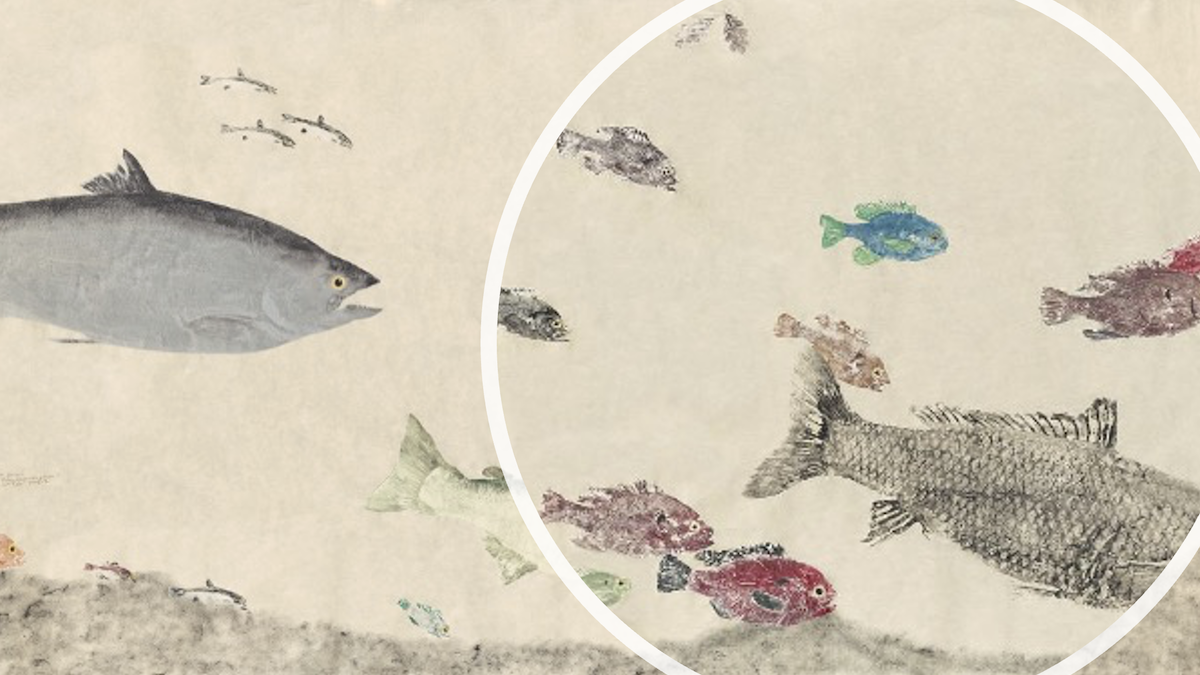
Our view of the Suisun Marsh when the weather becomes chilly, including Kimberly’s (top right, that’s me!) dazzling tule perch, Abigale’s wondrous starry flounder (middle left), Lynette’s swift Sacramento splittail (middle right), Kyle’s voracious common carp (bottom left), and Alex’s humble shokihaze goby (bottom right).

‘Twas a morning of field work, when all through our van
Not a researcher was sleeping, and to Suisun Marsh we ran;
Our waders and boots folded, all tucked in with care,
In hopes that bountiful fish, in our seines, would be there;

The researchers were nestled all snug on our boat ‘Junior,’
With visions of the otter trawl dancing on the slough floor;
Abigale Deen in her ’kerchief, and I in my cap,
Sipped on cucumber lime Gatorade, alert in a snap,

When out in the slough there arose such a clatter,
I leapt up from the stern to see what was the matter.
Up to the boat’s bow I flew like a flash,
Stared down at the water, curious of the splash.

The westerly wind on the water did blow,
Gave the illusion of movement to objects below,
When, what to my wondering eyes should appear,
But the winter seasonals and resident fishes all here,

With a slender old swimmer, so lively and quick,
I knew in a moment it must be Splittail (ST) Nick.
More rapid than eagles other fishes they came,
And he swished, and splashed, and called them by name;

“Now, tule perch! Now, common carp! Now, stickleback and threadie!
On, sucker! On, sculpin! On, yellowfin goby!

To the top of the waterways! To the cod end of the trawl!
Now dash away! Dash away! Dash away all!”

But I heard him exclaim, ere he swam out of sight,
“Happy fish-mas to all, and to all a good night!”

About the Author

Kimberly Evans is a Master’s student in the Graduate Group in Ecology. As a member of the Aquatic Research Collective (ARC) in the Center for Watershed Sciences, she studies long-term trends in the fishes of Suisun Marsh, focusing on the Sacramento Splittail.

Further Reading

Moyle, P. B., Baxter, R. D., Sommer, T., Foin, T. C., & Matern, S. A. (2004). Biology and population dynamics of sacramento splittail (Pogonichthys macrolepidotus) in the San Francisco Estuary: A review. San Francisco Estuary and Watershed Science, 2(2). https://doi.org/10.15447/sfews.2004v2iss2art3

Moyle, P. B., Manfree, A. D., & Fiedler, P. L. (Eds.). (2019). Suisun marsh: Ecological history and possible futures. University of California Press. https://doi.org/10.1525/9780520957329

To celebrate 15 years of the California WaterBlog during this season of giving, consider making a gift to the Center to help us create more meaningful opportunities for students across our programs.

Posted in Uncategorized | Tagged , | 1 Comment

Day 8 – Haikus

We invited haiku submissions from CWS members and friends to be a part of the 8th day of our California WaterBlog series, “12 Days of CWS“. A haiku is a traditional Japanese three-line poem (5-7-5 syllables) that focuses on capturing a moment, feeling, or image. We hope you enjoy… and leave us your own haiku in the comments section below!


It seeps through the ground
Replenishing aquifers
Groundwater recharge


Creeping and Crawling
California Invasive
Water Hyacinth


Toils All Day Long
An Indoor Ecologist
Will I go Outside

Danube River, Dürnstein, Austria. PC Christine Parisek 2025.

Valley fog lifts up
Feathers flutter through orchards
Sigh for the promise


Mosquitos floating
Mosquitos dancing for my blood
We hate you so much

Blinded by blood lust
Seeking me incessantly
The spray does nothing

[Anonymously dedicated to anyone who has done meadow work, stream work, or just any field work with mosquitos present… probably everyone. It is just something to deal with, and part of the fun of field work. :)]


Flows, feast or famine,
Flora, fauna, farms, and friends:
California.

Aerial view of wetlands. PC Ken James, CA DWR, 2025.


Watershed Building
Interdisciplinary
Full of Scientists


Water falls from high
River begins to wander
Floodplain comes alive

Putah Creek along the UC Davis campus (i.e., Pedrick Road). PC Peter B. Moyle, January  2011.

New rain is falling, 
Thirsty grounds long for storing. 
Can floods bring new hope? 
– By Helen E. Dahlke


Through a microscope
Pearl shining, a fish’s lens sits
History in layers
– By Danhong Ally Li

Adult Chinook Salmon Lens. Photo Credit: Alexandra Chu. 

Founded CWS
Jeff Mount and Peter Moyle
The Visionaries


Keys click, code won’t run
Outside, salmon spawn in streams
Life of a modeler

Putah Creek Salmon. PC Ken Davis, December 2013.


How do salmon
From distant valley rivers
Find our small creek? 

Looking for salmon
I see swirling yellow leaves
And a patch of clean gravel

On Valentine’s Day
Suckers were splashing  and spawning 
Not knowing  I was watching.

Fishing smallmouth bass 
We catch native pikeminnows.
A happy result.

On bright summer mornings
Fish dapple the creek’s surface 
Grabbing small mayflies.

– Haikus about Putah Creek, By Peter Moyle 

Putah Creek below Pedrick Road. PC Peter B. Moyle.

To celebrate 15 years of the California WaterBlog during this season of giving, consider making a gift to the Center to help us create more meaningful opportunities for students across our programs.

Posted in Uncategorized | Tagged , , , , , , , , , , , | Leave a comment

Day 7 – Pickles and Hidden Gems: The UC Davis Fish Collection

By Rachel Alsheikh

Dr. Peter Moyle and Rachel Alsheikh in the Ichthyology Collection room.

On the UC Davis campus, past the Watershed Sciences Building, past the cows and the Arboretum, there’s a nondescript building with a locked room. It’s a secret treasure trove: shelves upon shelves stacked with more than 8,000 jars of fish specimens preserved in ethanol. At over 30,000 fishes, it’s the fourth largest ichthyological research collection in the state, and it belongs to the Museum of Wildlife and Fish Biology (MWFB). If you’ve studied fish at UC Davis, you’ve almost certainly encountered the MWFB’s teaching specimens before, in a class like WFC120L or at an event like Picnic Day. A museum’s selected teaching specimens and its specimens on display get to meet the public that way, but few people have the opportunity to appreciate full behind-the-scenes research collections. Today, we’ll give you a sneak peek inside.

Distinguished Professor Emeritus and Center for Watershed Sciences co-founder, Dr. Peter Moyle established the Ichthyology Collection in 1972. It has been a time capsule for research ever since, spanning not only Dr. Moyle’s career but also those of many of his students. The resulting collection is one of the most modern representations of California freshwater and estuarine species at any institution, an important resource in the keeping of natural history. Part of the Fish Collection also consists of orphaned collections from other institutions, including the large San Jose State University collection of nearshore marine fishes, which was started by Professor Emeritus Dr. Jerry Smith, one of Peter Moyle’s first graduate students. And the Fish Collection doesn’t end there, with specimens from across the country, Hawaii to Alaska, Mexico, Sri Lanka, Antarctica, and more.

A handful of “pickled” specimens in lots: (left to right) frogfish, white-spotted puffer, guineafowl puffer, stout moray, trunkfish.

These specimens don’t sit idle, they actively contribute to research. They have helped scientists reassess fish taxonomy, clarify species phylogenies, and determine changing distributions. Their tissues have been used for genomic analysis. Some of them have even been featured on the WaterBlog for their importance as type specimens, the permanent vouchers used to describe a new species or subspecies. The oldest museum fish collections are nearly two centuries old (see the Smithsonian Institution National Museum of Natural History’s archive of the United States Exploring Expedition, 1838-1942): it’s impossible to predict everything collections-based research will discover in the future. Needless to say, we’ll be working with this collection to help find out.

To learn more about the Museum of Wildlife and Fish Biology, please visit mwfb.ucdavis.edu. You can also contact mwfb@ucdavis.edu or ralsheikh@ucdavis.edu

You can follow the MWFB on Instagram @museumofwfb.

If you’re interested in supporting the Fish Collection, you can contact us or do so here.

About the Author

Rachel Alsheikh is a Museum Specialist at the Museum of Wildlife and Fish Biology. She has been working at the MWFB since she was an undergraduate student. When she graduated in 2020, she also began working as the Project Manager for the Center for Watershed Sciences. She loves museums and museum specimens.

Further Reading

From the MWFB 

California’s Freshwater Fishes. Museum of Wildlife and Fish Biology.

Moyle, P. B., Buckmaster, N., and Su, Y. Taxonomy of the Speckled Dace Species Complex (Cypriniformes: Leuciscidae, Rhinichthys) in California, USA. Zootaxa. 2023; Vol. 5249, No. 5: 501–539.

Moyle, P. B. and Campbell, M. A. Cryptic Species of Freshwater Sculpin (Cottidae: Cottus) in California, USA. Zootaxa. 2022; Vol. 5154,  No. 5: 501–527.

Baumsteiger, J. and Moyle, P. B. A reappraisal of the California Roach/Hitch (Cypriniformes, Cyprinidae, Hesperoleucus/Lavinia) species complex. Zootaxa. 2019; Vol. 4543, No. 2: 221–240.

About natural history collections 

The Lost Species: Great Expeditions in the Collections of Natural History Museums by Christopher Kemp, Dry Storeroom No. 1: The Secret Life of the Natural History Museum by Richard Fortey, Curators: Behind the Scenes of Natural History Museums by Lance Grande.

Holmes, et. al. Natural history collections as windows on evolutionary processes. Molecular Ecology. 2016; Vol. 25, No. 16: 864-881.

To celebrate 15 years of the California WaterBlog during this season of giving, consider making a gift to the Center to help us create more meaningful opportunities for students across our programs.

Posted in Uncategorized | Tagged , , , | 1 Comment